Klondike Solitaire: The Complete Guide (2026)
Klondike Solitaire is the world's most popular card game, played by millions daily. Whether you call it "Classic Solitaire," "Patience," or simply "Solitaire," this timeless single-player game has captivated players since the late 1800s. This comprehensive guide will teach you everything from basic rules to advanced winning strategies.
🎴 Play Free Klondike Solitaire Now📖 Table of Contents
- What is Klondike Solitaire?
- How to Play: Complete Rules
- Game Setup & Layout
- Scoring System
- Winning Strategies & Tips
- Popular Variations
- Winning Odds & Statistics
- Built-in Solver
- Frequently Asked Questions
What is Klondike Solitaire?
Klondike Solitaire is a single-player card game played with a standard 52-card deck. The objective is to move all cards to four foundation piles, organizing them by suit from Ace to King. It became globally popular when Microsoft included it in Windows 3.0 in 1990, making it one of the most-played computer games of all time.
- Players: 1 (single-player game)
- Deck: Standard 52-card deck
- Difficulty: Medium (requires strategy and planning)
- Average Win Rate: 79-81% of games are theoretically winnable
- Typical Game Time: 5-15 minutes
How to Play Klondike Solitaire: Complete Rules
Game Objective
The goal is to build four foundation piles, one for each suit (Hearts ♥, Diamonds ♦, Clubs ♣, Spades ♠), starting with the Ace and ending with the King, in ascending order.
Initial Setup
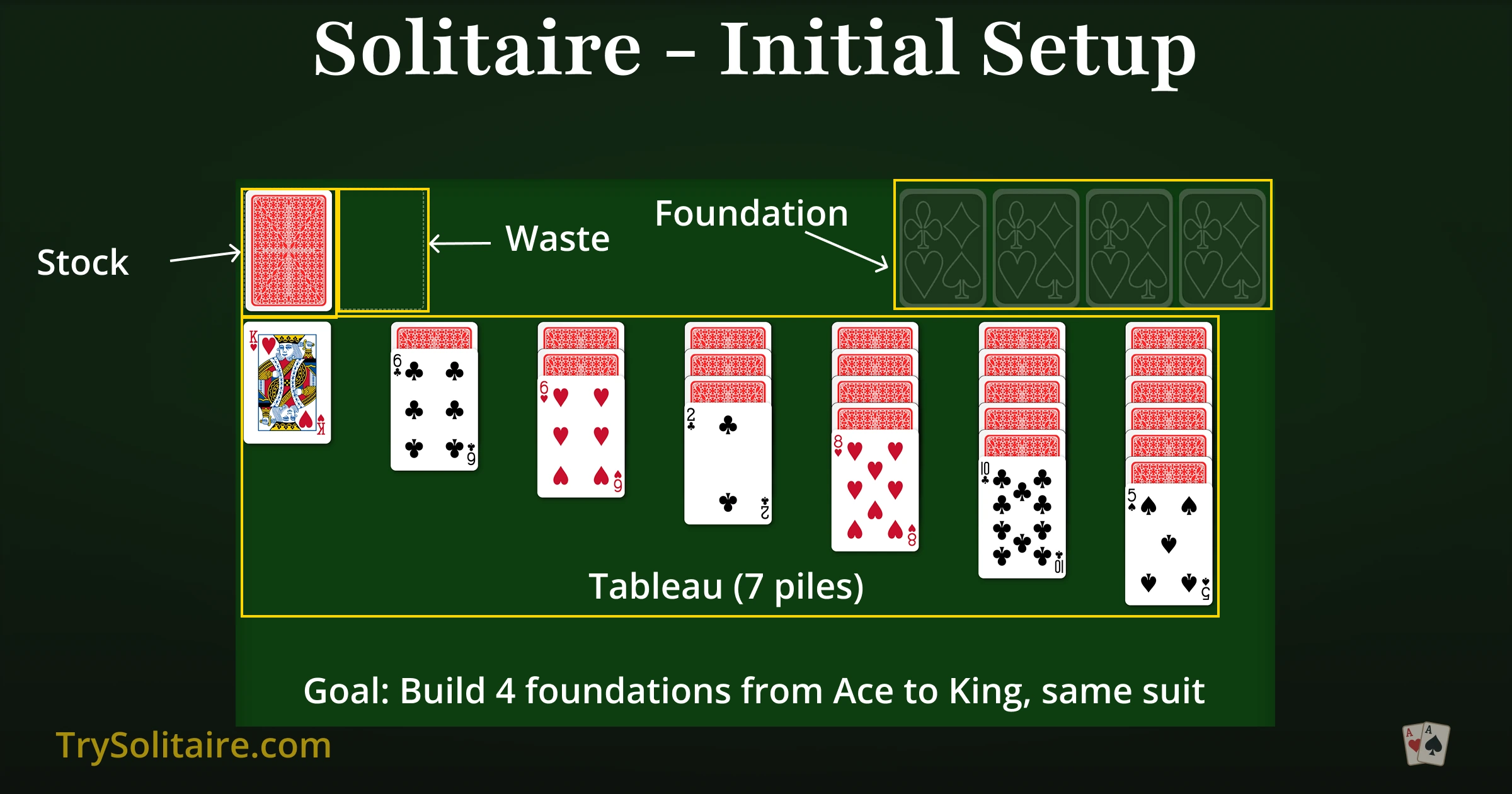
Klondike Solitaire begins with a specific card layout:
- Tableau: Deal 7 piles of cards from left to right:
- 1st pile: 1 card (face-up)
- 2nd pile: 2 cards (top card face-up, 1 face-down)
- 3rd pile: 3 cards (top card face-up, 2 face-down)
- Continue this pattern through the 7th pile (1 face-up, 6 face-down)
- Stock Pile: The remaining 24 cards form the stock pile (face-down)
- Foundation Piles: Four empty spaces above the tableau where you'll build your winning stacks
- Waste Pile: An empty space next to the stock for drawn cards
Gameplay Rules
Moving Cards in the Tableau
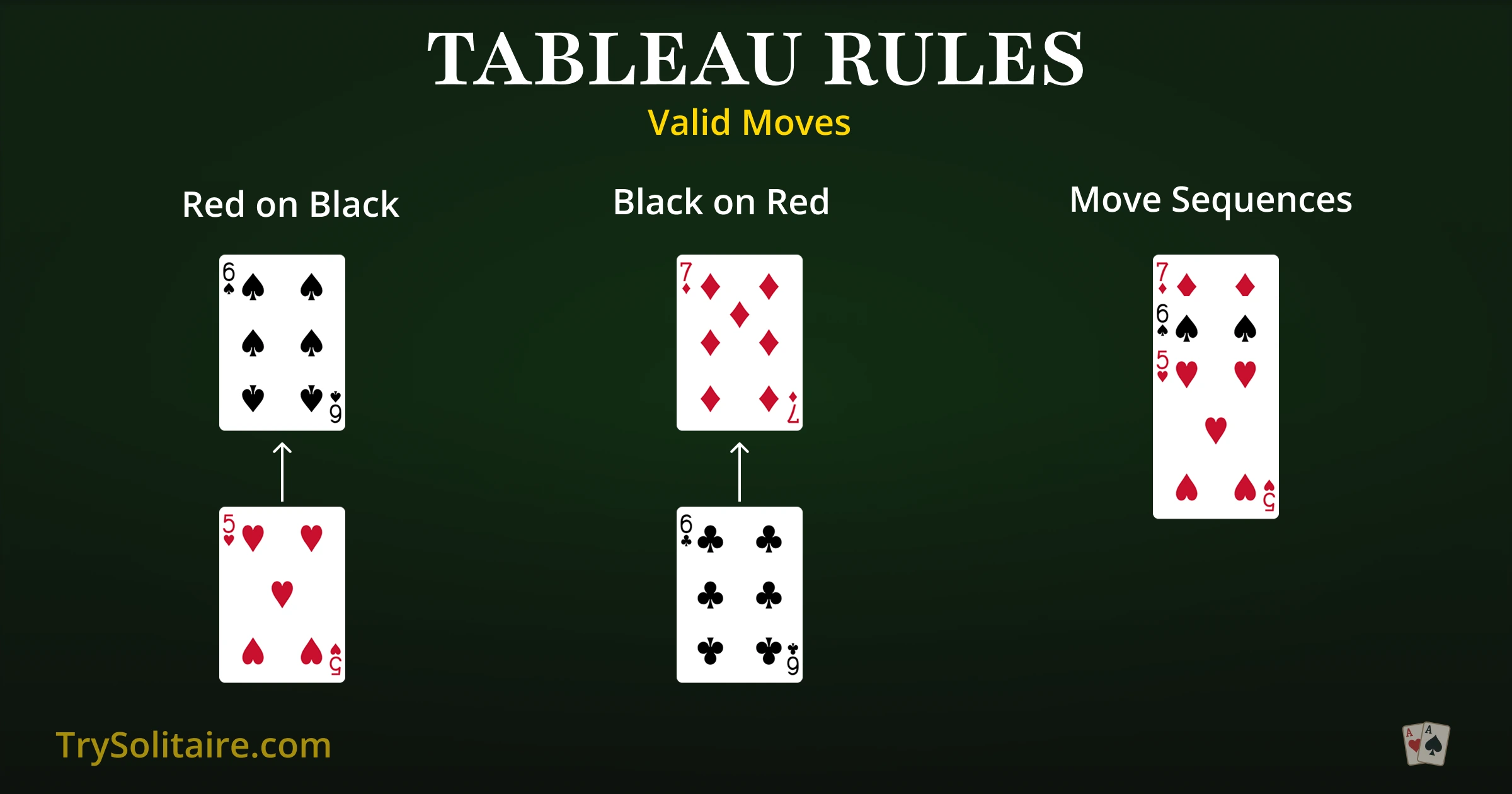
- Stack cards in descending order (King, Queen, Jack, 10, 9, etc.)
- Alternate colors (red on black, black on red)
- Example: A red 7 can be placed on a black 8
- You can move sequences of properly stacked cards together
- When a face-down card is exposed, flip it face-up
- Only Kings (or sequences starting with Kings) can fill empty tableau spaces
✓ Valid Tableau Moves
✗ Invalid Tableau Moves
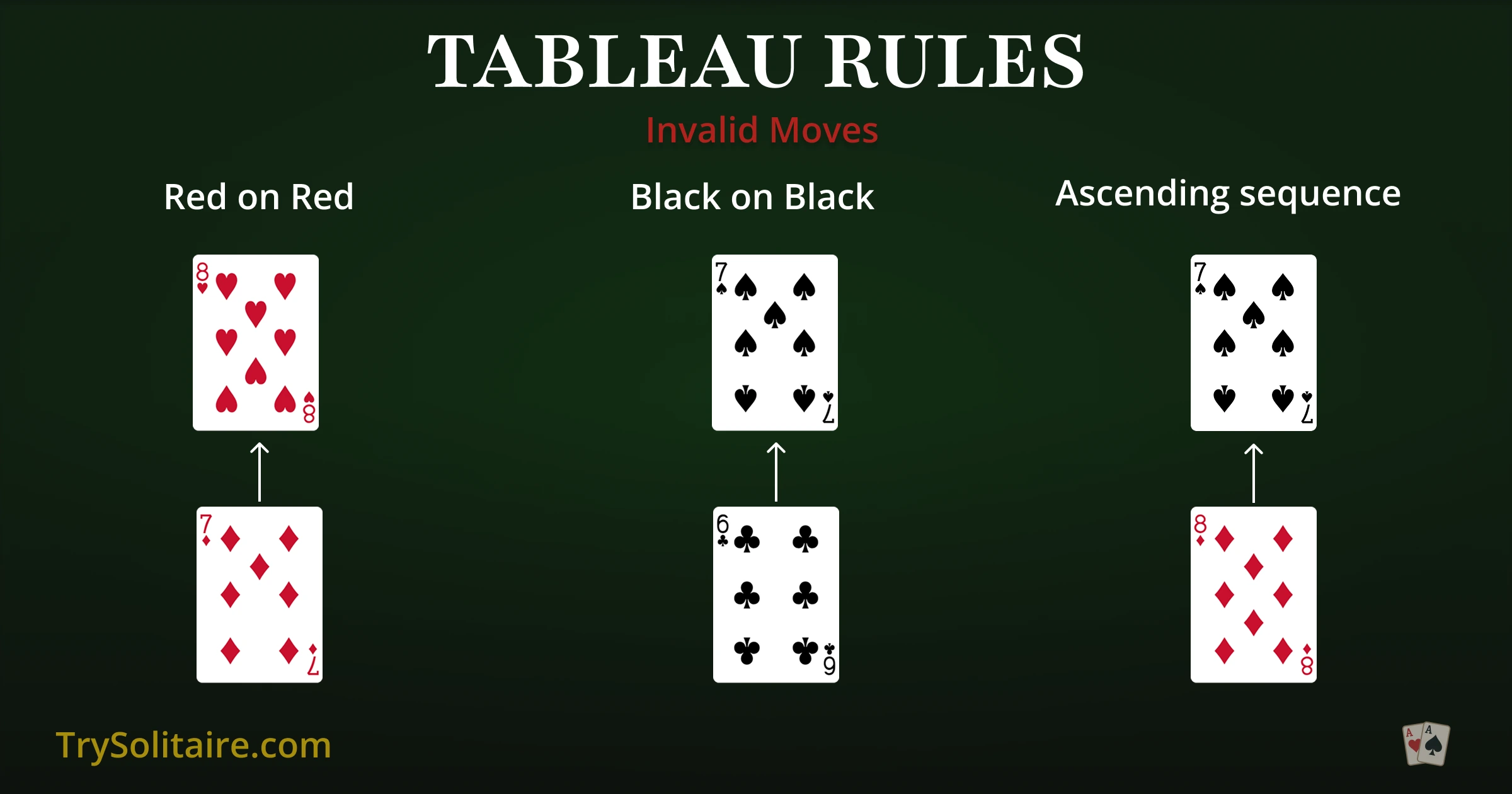
Tableau Rules Summary
- Descending rank order: K→Q→J→10→9→8→7→6→5→4→3→2→A
- Alternating colors: Red (♥ ♦) ↔ Black (♠ ♣)
- Move single cards or complete sequences
- Only Kings can fill empty columns
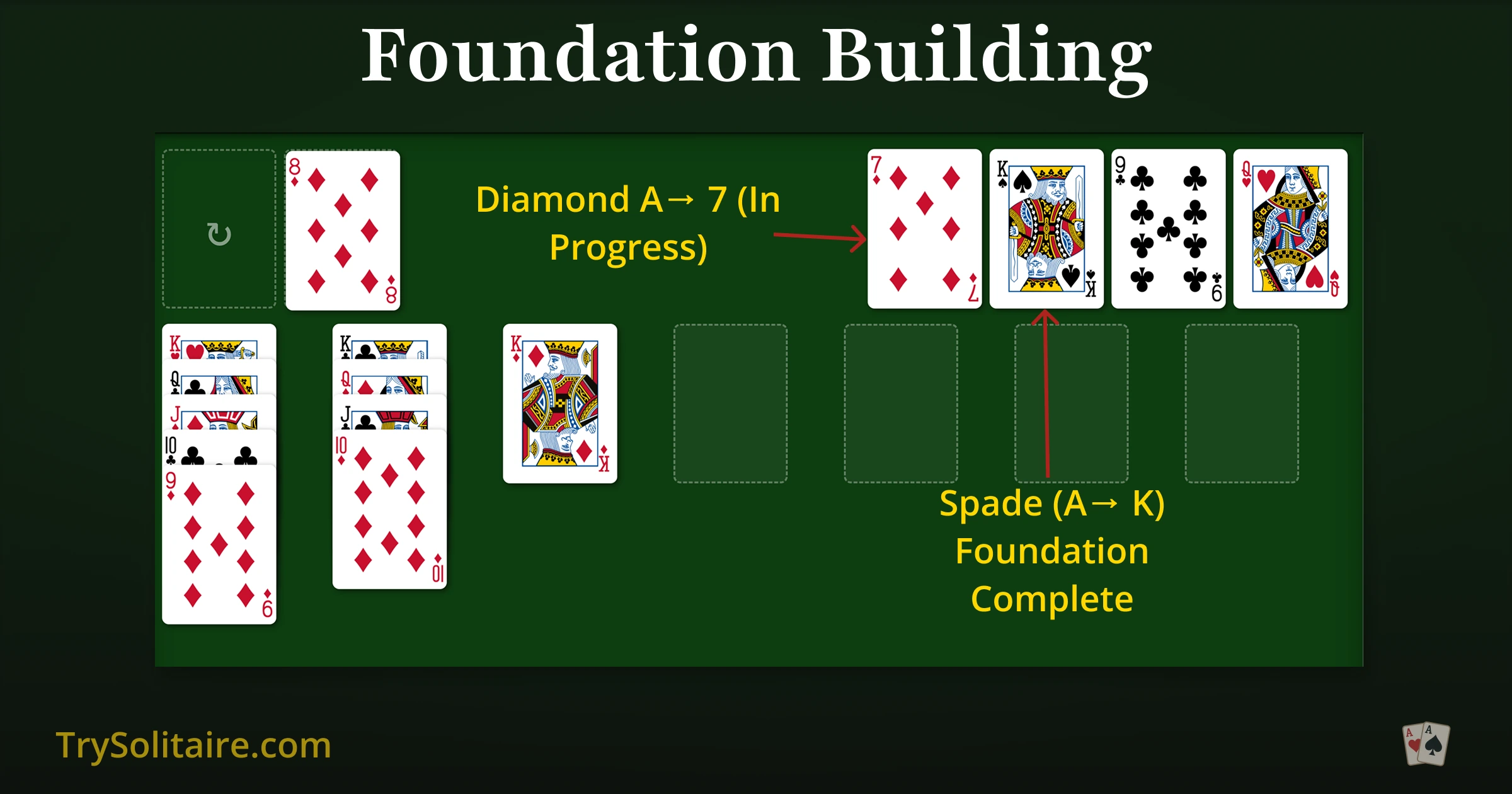
Building Foundation Piles
- Start each foundation with an Ace
- Build upward in the same suit (A→2→3→4...→K)
- Cards can be moved back from foundations to tableau (with a -10 score penalty)
- The game is won when all four foundations are complete
Foundation Rules
- Each foundation builds ONE suit only (♥ ♦ ♣ ♠)
- Must start with an Ace (A) - No other card can begin a foundation
- Build in ascending order: A → 2 → 3 → 4 → 5 → 6 → 7 → 8 → 9 → 10 → J → Q → K
- Only ONE card at a time can be moved to a foundation
- Win when all 4 foundations complete! (52 cards total: 13 per foundation)
Using the Stock Pile
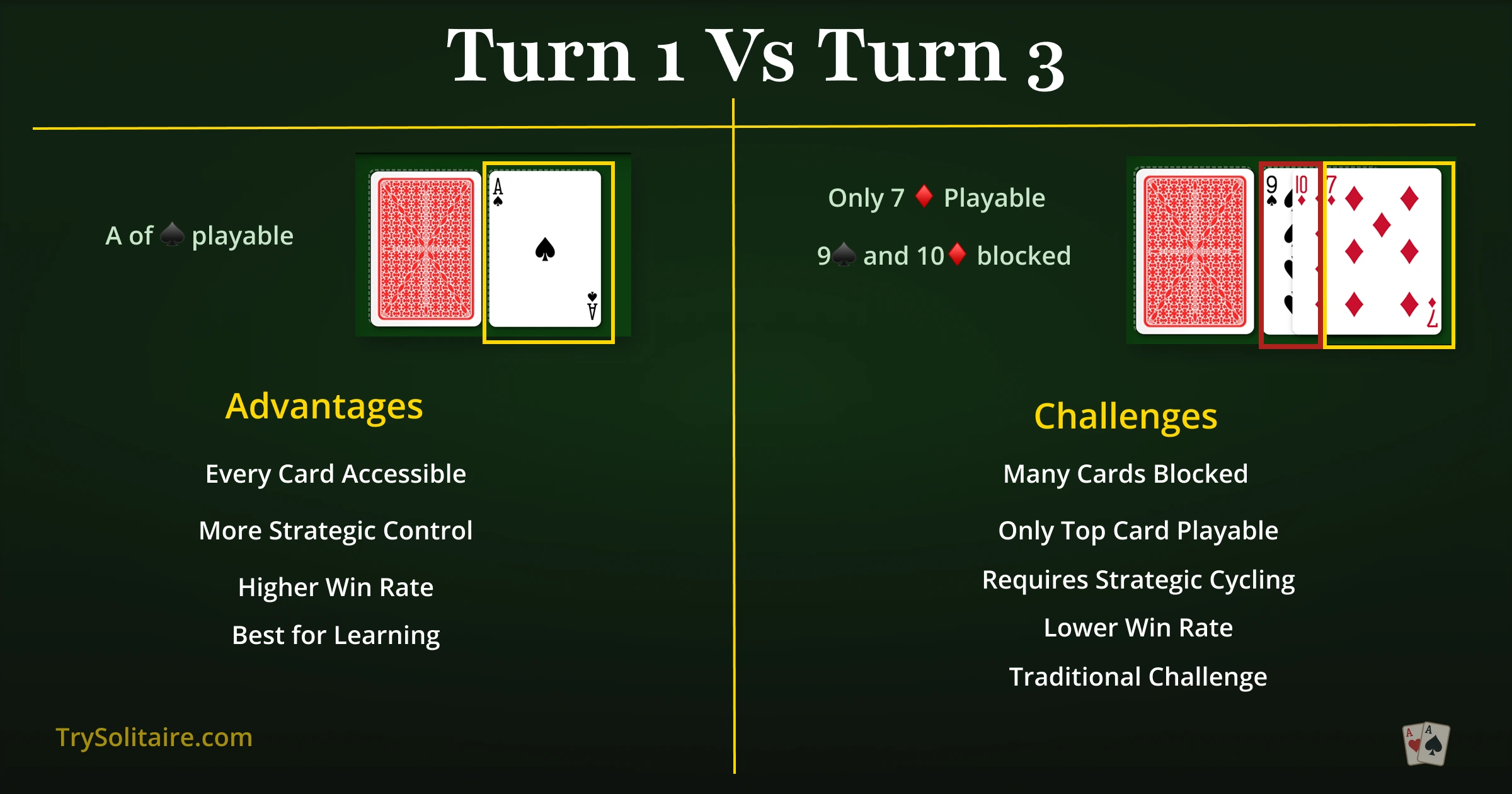
- Draw-1 Mode: Turn over one card at a time (easier, recommended for beginners)
- Draw-3 Mode: Turn over three cards at a time (harder, traditional rules)
- Only the top card of the waste pile can be played
- Cycle through the stock pile unlimited times (most online versions)
Which Mode Should You Choose?
- Are learning Klondike for the first time
- Want more strategic control over your moves
- Prefer a higher chance of winning (79% vs 30%)
- Enjoy planning multiple moves ahead
- Like having access to every card in the deck
- Want the traditional, classic Klondike experience
- Seek a more challenging game with lower win rates
- Are comfortable with luck playing a bigger role
- Have mastered Turn 1 and want to test your skills
- Enjoy games where many cards may be inaccessible
Scoring System (Simplified Modern Scoring)
Our version uses simplified modern scoring to help you track your progress and challenge yourself:
- Move to Foundation: +10 points per card
- Reveal Face-Down Card: +5 points each
- King to Empty Column: +20 points (strategic bonus)
- Win Bonus: +500 points
- Time Bonus: +2 points per second under 5 minutes (300 seconds)
Example Score: If you complete a game in 3 minutes (180 seconds) with all 52 cards moved to foundations and revealing 21 face-down cards: (52 × 10) + (21 × 5) + 500 + (120 × 2) = 520 + 105 + 500 + 240 = 1,365 points
Your top 5 scores are saved locally so you can track your improvement over time. Try to beat your personal best!
Winning Strategies & Expert Tips
Essential Strategies for Beginners
- Prioritize Exposing Hidden Cards
Your first priority should always be revealing face-down cards. Focus on columns with the most face-down cards, as they offer the most potential moves.
- Don't Empty a Tableau Pile Without a King
Empty spaces are valuable, but they can only be filled with Kings. Don't create an empty space unless you have a King (or a sequence starting with a King) ready to place there.
- Build Evenly Across Columns
Try to keep columns roughly the same height. This gives you more flexibility and makes it easier to move cards between columns.
- Think Before Moving to Foundations
Don't rush to move cards to foundations, especially low cards (2s, 3s, 4s). You might need them in the tableau for building sequences. Move to foundations when cards won't be useful in the tableau anymore.
- Aces and Deuces: Move Early
Move Aces to foundations immediately. Deuces can also be moved safely—you won't need them in the tableau.
Advanced Winning Tactics
- The "Color Strategy"
When you have a choice, build in a way that maximizes color flexibility. For example, if you can place either a red 7 or a black 7 on a black 8, consider which opens more future moves.
- Plan Multiple Moves Ahead
Before making a move, think 2-3 moves ahead. Ask yourself: "If I make this move, what becomes possible next?" Look for move sequences that expose multiple face-down cards.
- The "Breaking Order" Technique
Sometimes you need to break up a good sequence in one column to expose cards in another. This is acceptable if it reveals multiple face-down cards or creates better long-term opportunities.
- Manage the Stock Pile Wisely
Before drawing from the stock, ensure you've made all possible moves in the tableau. Each draw from the stock should be a deliberate decision, not a default action.
- Foundation Timing Strategy
A good rule: don't move cards to foundations unless they're at least 2-3 ranks lower than the lowest card still in play. For example, if you still have 9s in the tableau, it's safe to move 6s and lower to foundations.
- Expose face-down cards first
- X-ray (plan) multiple moves ahead
- Protect empty spaces for Kings
- Organize columns evenly
- Stock pile - use last
- Evaluate before moving to foundations
Popular Klondike Variations
| Variation | Key Difference | Difficulty |
|---|---|---|
| Draw-1 (Easy) | Draw one card at a time from stock | Easy |
| Draw-3 (Classic) | Draw three cards at a time from stock | Hard |
| Vegas Solitaire | Scoring system with money, limited stock cycles | Expert |
| Thoughtful Solitaire | All cards dealt face-up (no hidden cards) | Medium |
Winning Odds & Statistics
Understanding the mathematics behind Klondike helps set realistic expectations:
- Theoretical Winnable Games: 79-81% of all random deals
- Actual Win Rate (Average Player): 10-30%
- Expert Win Rate: 43-55%
- Draw-1 vs Draw-3: Draw-1 has roughly double the win rate of Draw-3
- Total Possible Games: Over 8 million unique starting positions
Built-in Solver: Check If Your Game Is Winnable
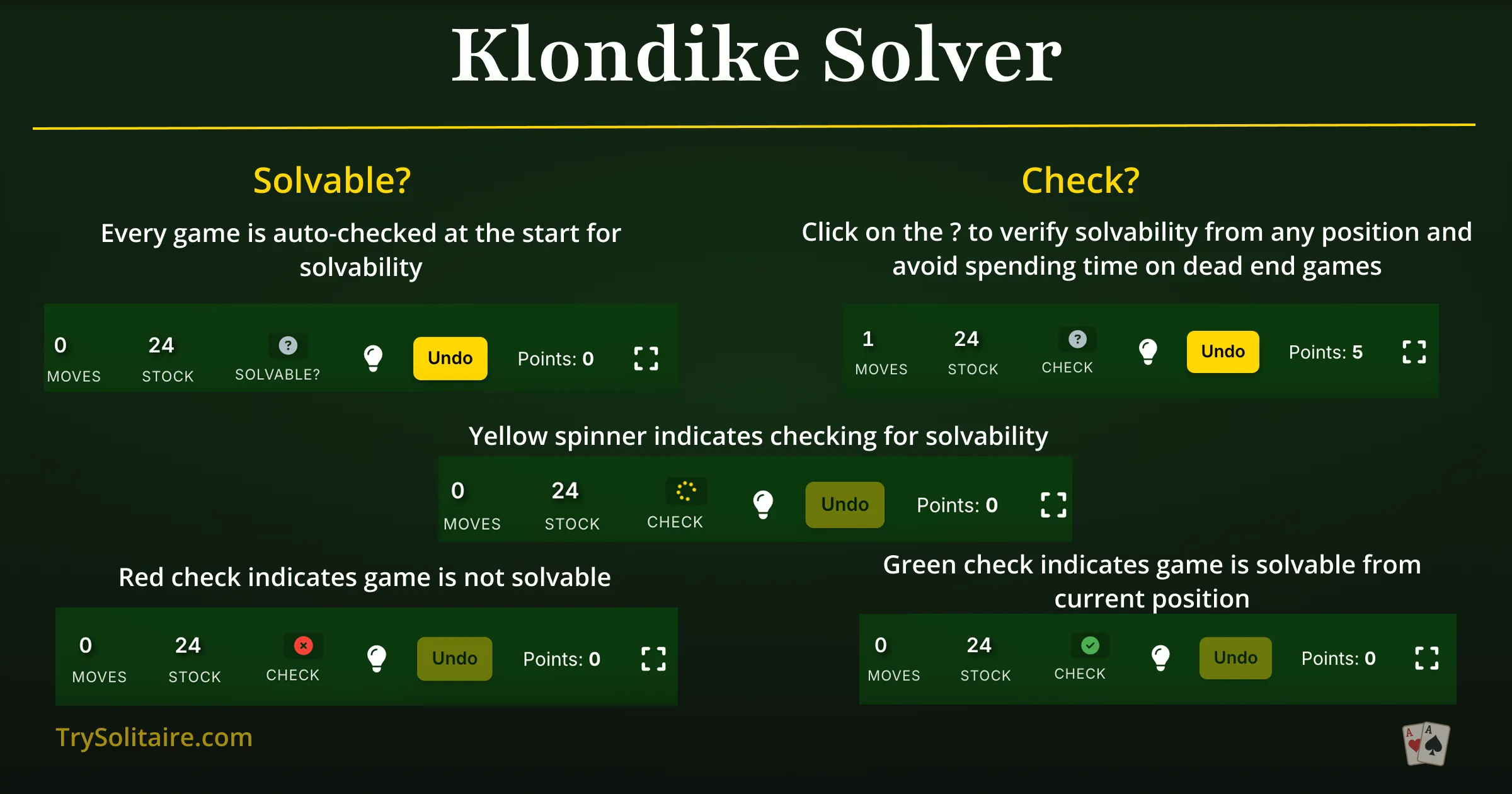
Remember those statistics above — about 21% of deals being impossible? TrySolitaire has a built-in Klondike solver that analyzes your game in real time and tells you whether a winning path exists from your current position.
Key Solver Features
- Real-Time Analysis — The solver checks your position as you play, showing a green checkmark (winnable) or red X (unsolvable) in the toolbar.
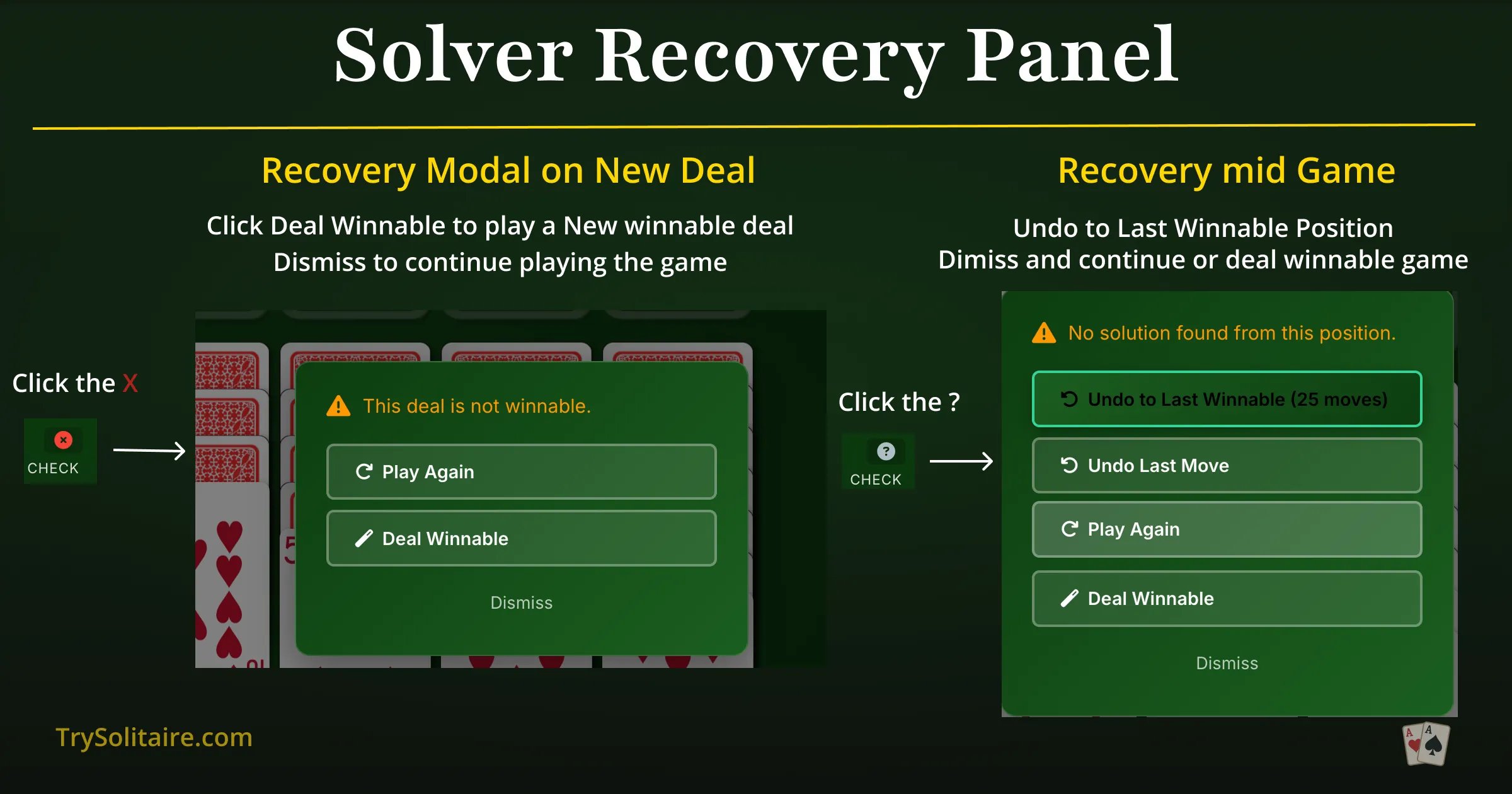
- Deal Winnable Game — Start with a deal that's guaranteed solvable. Perfect for practicing strategy without the frustration of impossible games.
- Undo to Winnable — Made a move that killed your chances? The solver can automatically undo back to the last position where a winning path existed.
Want to dive deeper? Read our complete Solitaire Solver guide or learn how to tell if your game is winnable.
Frequently Asked Questions (FAQ)
Can you always win at Klondike Solitaire?
No. Approximately 20-21% of Klondike deals are mathematically impossible to win, regardless of how perfectly you play. However, with optimal strategy, you can win about 79-81% of games.
What's the difference between Klondike and regular Solitaire?
"Solitaire" is a generic term for single-player card games. Klondike is the specific version most people think of when they say "Solitaire." There are over 100 different solitaire games, but Klondike is by far the most popular.
How do you increase your chances of winning?
Focus on these three priorities: (1) Expose face-down cards, (2) Build evenly across columns, and (3) Only create empty spaces when you have a King ready. These strategies alone can double your win rate.
Is Draw-1 or Draw-3 better?
Draw-1 is easier and better for learning. Draw-3 is the traditional rule and provides more challenge. Most casual players prefer Draw-1, while experienced players often choose Draw-3 for added difficulty.
Should I move cards to foundations immediately?
No! This is a common mistake. Keep lower-ranked cards (2-6) in the tableau longer—you might need them for building sequences. Move cards to foundations only when they won't be useful in the tableau.
Can you undo moves in Klondike?
In most online versions (including ours), yes! The undo feature is a great learning tool. Traditional card games don't allow undos, but digital versions typically do.
How long does a typical game take?
Most games take 5-15 minutes. Experienced players can complete easier deals in under 5 minutes, while challenging deals might take 20+ minutes of careful planning.
How do I know if my Klondike game is winnable?
TrySolitaire has a built-in solver that checks your game in real time. Look for the solver icon in the toolbar: a green checkmark means your game is winnable, a red X means it's unsolvable from the current position. You can also use "Deal Winnable" to start with a guaranteed-solvable hand. Learn more about the solver →
Are all Klondike games winnable?
No — about 21% of Klondike Draw 1 deals and approximately 70% of Draw 3 deals are mathematically impossible to win, regardless of strategy. TrySolitaire's solver identifies these unwinnable deals so you don't waste time on them. Learn about solitaire winnability →
Why Klondike Solitaire is Perfect for You
Klondike Solitaire isn't just a game—it's a mental workout that offers numerous benefits:
- Improves concentration and focus – Requires sustained attention and strategic planning
- Enhances problem-solving skills – Each game presents unique challenges to solve
- Reduces stress – Provides a calming, meditative experience
- Sharpens memory – Remembering card locations and planning sequences exercises your brain
- No time pressure – Play at your own pace
- Instant gratification – Quick games with clear win/loss outcomes
Ready to Play?
Now that you've mastered the rules and strategies, it's time to put your knowledge to the test! Our free online Klondike Solitaire offers beautiful graphics, smooth animations, and all the features you need:
- Choose between Draw-1 or Draw-3 modes
- Unlimited undo/redo
- Hint system when you're stuck
- Auto-complete when you've won
- Built-in solver to check if your game is winnable
- "Deal Winnable" option for guaranteed-solvable games
- Statistics tracking (games played, win rate, best time)
- Works on all devices (mobile, tablet, desktop)
- No downloads, no registration, 100% free forever
Explore More Solitaire Games
Love Klondike? Try these other popular solitaire variations:
- Spider Solitaire – Uses two decks, build sequences in the same suit
- FreeCell Solitaire – Almost every game is winnable with perfect play (99.99%!)
- TriPeaks Solitaire – Fast-paced pyramid clearing game
- Pyramid Solitaire – Match cards that add up to 13
- Golf Solitaire – Clear the tableau in the fewest moves
🔍 Solver & Winnability
- Solitaire Solver Guide — Check if your game is winnable
- Is My Game Winnable? — Understanding solitaire solvability
📚 Related Articles
Last updated: February 2026 | TrySolitaire.com – The world's best free solitaire experience