Spider Solitaire: The Ultimate Guide to Mastering the Eight-Legged Challenge
Spider Solitaire is considered by many to be the king of solitaire games. Using two full decks (104 cards), this challenging game rewards strategic thinking, careful planning, and patience. While harder than Klondike, Spider offers deeper gameplay and incredible satisfaction when you win. This complete guide will transform you from a beginner to an expert.
🕷️ Play Free Spider Solitaire Now📖 Quick Navigation
- What is Spider Solitaire?
- Complete Rules & How to Play
- Difficulty Levels (1, 2, & 4 Suit)
- Scoring System
- 11 Winning Strategies
- Common Mistakes to Avoid
- Spider vs. Klondike
- FAQ
What is Spider Solitaire?
Spider Solitaire is a two-deck solitaire card game where you build sequences of cards in descending order. The name "Spider" comes from the game's eight foundation piles (like a spider's eight legs) where you need to build eight complete sequences from King to Ace.
- Decks: 2 (104 cards total)
- Tableau Columns: 10
- Goal: Build 8 complete King-to-Ace sequences
- Difficulty: High (requires strategic planning)
- Win Rate: Approximately 30-40% of games are winnable
- Popularity: #1 two-deck solitaire game worldwide
How to Play Spider Solitaire: Complete Rules
Game Objective
Remove all 104 cards from the tableau by creating eight complete sequences of King through Ace in the same suit. When a complete suited sequence (K-Q-J-10-9-8-7-6-5-4-3-2-A) is formed, it's automatically removed to the foundation.
Initial Setup
- 10 tableau columns:
- First 4 columns: 6 cards each (top card face-up)
- Last 6 columns: 5 cards each (top card face-up)
- Total: 54 cards dealt
- Stock pile: Remaining 50 cards (dealt 10 at a time)
- Foundation area: Space for 8 completed sequences
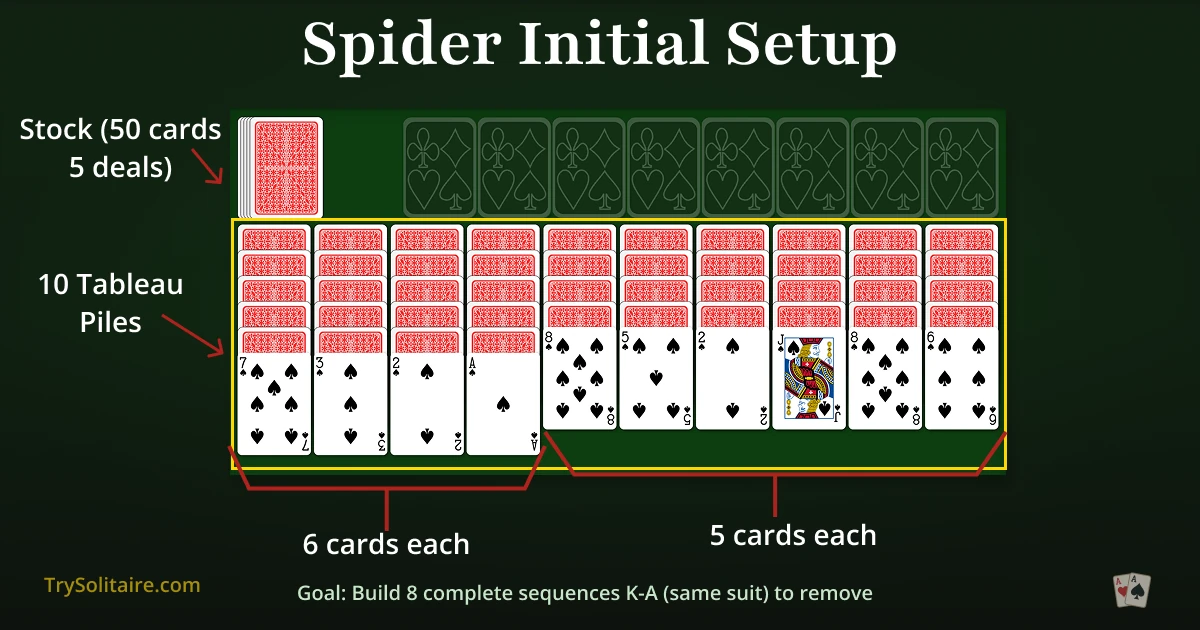
Spider Solitaire Setup Details
- Total Cards: 104 (two complete 52-card decks)
- Tableau Columns: 10 columns total
- First 4 columns: 6 cards each (5 face-down, 1 face-up)
- Last 6 columns: 5 cards each (4 face-down, 1 face-up)
- Stock Pile: 50 remaining cards (5 deals × 10 cards)
- Objective: Build 8 complete King-to-Ace sequences to clear all cards
Core Gameplay Rules
1. Building Sequences
- Stack cards in descending order (K, Q, J, 10, 9, 8, 7, 6, 5, 4, 3, 2, A)
- You can build on any suit, but mixing suits creates problems
- Example: You can place a 7 of Hearts on an 8 of Spades, but it's not ideal
2. Moving Cards
- Single cards: Can be moved to any valid position
- Sequences: Only same-suit sequences can be moved together as a unit
- Mixed-suit sequences are "locked" and cards must be moved one at a time
3. Empty Columns
- Any card or valid sequence can fill an empty column
- Empty columns are extremely valuable for maneuvering
- Try to create and maintain at least one empty column
4. Stock Pile
- When stuck, deal 10 new cards (one to each column)
- Important: You cannot deal if any column is empty
- 5 deals available (50 cards ÷ 10 cards per deal)
- Each deal makes the game harder—use only when necessary
5. Winning the Game
- When you complete a same-suit K-A sequence, it's removed automatically
- Win by removing all 8 sequences (all 104 cards)
- If you run out of moves with cards remaining, you lose
✓ Same suit: All 13 cards must be the same suit (♠ ♥ ♦ ♣)
✓ Descending order: Must be in perfect descending sequence from King down to Ace
✓ Automatic removal: Complete sequences clear immediately, freeing up tableau space
✓ Win condition: Clear all 8 sequences (104 cards ÷ 13 = 8 sequences) to win!
Difficulty Levels: 1, 2, or 4 Suits?
Spider Solitaire offers three difficulty levels based on the number of suits used:
| Level | Suits Used | Difficulty | Best For |
|---|---|---|---|
| 1 Suit | ♠ Spades only (8 decks) | Easy | Beginners learning the game |
| 2 Suits | ♠ Spades & ♥ Hearts (4 decks each) | Hard | Intermediate players, best balance |
| 4 Suits | All suits (2 complete decks) | Expert | Advanced players seeking maximum challenge |
Cards: 104 Spades
Strategy: All cards compatible - focus on sequencing strategy
Cards: 52 of each suit
Strategy: Suit management required - build in-suit when possible
Cards: 26 of each suit
Strategy: Expert-level planning - most builds will be mixed-suit
Scoring System (Standard Spider Scoring)
Our version uses traditional Spider scoring to help you track your performance:
- Starting Score: 500 points
- Each Move: -1 point (encourages efficient play)
- Complete Suit Removed: +100 points (8 suits total)
- Win Bonus: +200 points (all 8 suits cleared)
Example Score: If you complete a 1-suit Spider game in 120 moves: 500 - 120 + (8 × 100) + 200 = 500 - 120 + 800 + 200 = 1,380 points
The fewer moves you use, the higher your score! Your top 5 scores are saved locally. Challenge yourself to improve your efficiency and maximize your points.
11 Proven Strategies to Win Spider Solitaire
• Entire sequence (10-9-8-7♠) can move together
• Maximum mobility and flexibility
• Easy to reorganize if needed
• Path to completing full King-to-Ace sequence
• Sequence "locked" - can't move together
• 6♥ breaks the Spades run
• Must move cards individually
• Severely limits future options
Strategy #1: Build in Suit Whenever Possible
The Golden Rule of Spider. Always prefer same-suit builds over mixed-suit builds. A 7♠ on 8♠ is infinitely better than 7♥ on 8♠, even if both are legal moves.
Why it matters: Same-suit sequences can be moved as a unit, giving you mobility. Mixed sequences lock cards together, severely limiting your options.
Strategy #2: Expose Hidden Cards as Priority #1
Your primary goal should always be revealing face-down cards. Each hidden card you expose:
- Gives you a new card to work with
- Opens up potential moves
- Helps you plan future sequences
Pro tip: Prioritize columns with the most face-down cards first.
Strategy #3: Create and Preserve Empty Columns
Empty columns are your most powerful tool. They allow you to:
- Temporarily store cards while rearranging
- Break up mixed sequences
- Move long sequences of cards
- Create space for strategic plays
Strategy #4: Don't Deal from Stock Too Early
Before dealing new cards from the stock:
- Exhaust ALL possible moves in the tableau
- Try to create at least one empty column
- Organize your sequences as much as possible
- Plan where the new cards will go
Remember: Each deal makes the game 10 cards harder. Use stock as a last resort.
Strategy #5: Build Downward from Kings
When you get a King, try to build a complete sequence under it immediately. Kings can't be moved onto other cards, so:
- Place Kings in empty columns when possible
- Start building K→Q→J sequences right away
- Protect King-started sequences—they're your path to victory
Strategy #6: Plan Multiple Moves Ahead
Spider rewards forward-thinking. Before each move, ask yourself:
- "What will this expose?"
- "Does this help build a complete sequence?"
- "Am I creating or breaking suit runs?"
- "Will this move block future options?"
Strategy #7: Avoid Breaking Suited Runs
Once you've built a same-suit sequence, protect it! Breaking a 9♠-8♠-7♠ run to make a different move is usually a mistake unless:
- It exposes multiple face-down cards
- It creates an empty column
- It completes a different sequence
Strategy #8: Know When to Build Mixed Suits
Sometimes you must build mixed suits. It's acceptable when:
- You're exposing a face-down card
- It's a temporary move you can undo later
- You have an empty column to help fix it
- NEVER do it just to "organize" cards
Strategy #9: The "Remove Complete Sequences ASAP" Principle
Unlike Klondike where you might delay moving cards to foundations, in Spider you want to complete and remove sequences as fast as possible. Each removed sequence:
- Frees up 13 card spaces
- Reduces visual clutter
- Makes the game more manageable
- Gets you closer to victory!
Strategy #10: Work on Multiple Sequences Simultaneously
Don't fixate on completing just one sequence. Spread your effort across multiple partial sequences. This gives you more flexibility and options.
Strategy #11: Learn Common Patterns
With practice, you'll recognize winning patterns:
- The "Staircase": Building sequences that step down across columns
- The "Tunnel": Creating a clear path to expose buried cards
- The "Swap": Using empty columns to reorganize mixed sequences into suited ones
5 Common Mistakes (and How to Avoid Them)
Mistake #1: Building Mixed Suits Carelessly
The problem: New players build any descending sequence without considering suit.
The fix: Ask "Is this same-suit?" before every build. If not, only proceed if it exposes cards or is easily reversible.
Mistake #2: Filling Empty Columns Thoughtlessly
The problem: Players fill empty columns with whatever card is convenient.
The fix: Only fill empty columns with Kings or when absolutely necessary for another move. Empty columns are gold—don't waste them!
Mistake #3: Dealing from Stock Too Quickly
The problem: Running to the stock pile when moves are still available.
The fix: Triple-check for moves before dealing. Even one missed move can be the difference between winning and losing.
Mistake #4: Ignoring Column Balance
The problem: Creating very tall columns while others remain short.
The fix: Try to keep columns roughly even. Extremely tall columns become unmanageable.
Mistake #5: Not Planning Ahead
The problem: Making moves without considering consequences.
The fix: Think 2-3 moves ahead. Spider punishes impulsive decisions!
Spider vs. Klondike: Which is Better?
| Aspect | Spider Solitaire | Klondike Solitaire |
|---|---|---|
| Decks Used | 2 decks (104 cards) | 1 deck (52 cards) |
| Difficulty | Harder, more strategic | Moderate, good for beginners |
| Luck vs. Skill | 70% skill, 30% luck | 50% skill, 50% luck |
| Average Game Time | 15-30 minutes | 5-15 minutes |
| Win Rate | 30-40% (2-suit) | 10-30% (typical) |
| Best For | Strategy lovers, patient players | Quick games, casual play |
Bottom line: Spider is deeper and more rewarding, but requires more time and patience. Klondike is perfect for quick, casual sessions. Try both!
Frequently Asked Questions
What's the best difficulty level for Spider Solitaire?
2-suit Spider is widely considered the best balance of challenge and fairness. 1-suit is too easy for most players, while 4-suit is brutally difficult. Start with 1-suit to learn, then graduate to 2-suit.
Can every Spider Solitaire game be won?
No. Approximately 30-40% of 2-suit Spider games are winnable with perfect play. 4-suit Spider is even lower (under 10%). However, most losses are due to suboptimal play, not impossible deals.
How many moves does it take to win Spider Solitaire?
Expert players can win 2-suit Spider in 100-120 moves. Average players typically use 150-200+ moves. The fewer moves, the better your strategy!
Should I always build in suit?
Ideally, yes. But sometimes you must build mixed suits to expose hidden cards or create necessary moves. The key is minimizing mixed-suit builds and fixing them when possible.
What's the hardest part of Spider Solitaire?
Managing the middle game—after the first few deals but before sequences start completing. This is where most games are won or lost. Focus on: (1) maintaining empty columns, (2) building suited runs, and (3) exposing cards efficiently.
Is Spider Solitaire good for your brain?
Yes! Spider Solitaire is excellent for cognitive development. It improves planning skills, pattern recognition, working memory, and strategic thinking. Many players find it more mentally stimulating than Klondike.
Ready to Become a Spider Master?
Spider Solitaire is challenging, but incredibly rewarding. Each victory feels earned, not lucky. Our free version includes:
- All three difficulty levels (1, 2, and 4 suits)
- Unlimited undo/redo for learning
- Hint system when stuck
- Move counter and timer
- Beautiful card designs
- Statistics tracking
- Works on all devices
- 100% free, no ads, no downloads
Explore More Solitaire Games
- Klondike Solitaire – The classic everyone knows
- FreeCell – Almost every game is winnable!
- TriPeaks – Fast-paced pyramid clearing
- Pyramid – Math-based pairing game
- Golf – Clear the tableau in fewest moves
📚 Related Articles
Last updated: October 2025 | TrySolitaire.com – The world's best free solitaire experience