FreeCell: The Most Winnable Solitaire Game
Last updated: November 15, 2025
Experience the most strategic and skill-based solitaire variant ever created. FreeCell Solitaire stands apart from all other card games with one remarkable feature: 99.99% of deals are winnable with perfect play. Unlike luck-dependent variants like Klondike, FreeCell rewards careful planning, strategic thinking, and patience. Every card is visible from the start, transforming solitaire from a casual pastime into a chess-like mental challenge where your decisions determine success.
▶ Play FreeCell Free Now - No Download RequiredWhat is FreeCell Solitaire?
FreeCell Solitaire is a single-player card game that revolutionized solitaire by making skill more important than luck. Invented by Paul Alfille in 1978 and popularized by Microsoft Windows, FreeCell uses a standard 52-card deck but introduces a game-changing mechanic: four "free cells" that serve as temporary storage spaces for individual cards.
The objective mirrors traditional solitaire - build four foundation piles from Ace to King, sorted by suit - but the path to victory requires significantly more strategic depth. Unlike Klondike where hidden cards introduce randomness, every card in FreeCell is dealt face-up from the beginning. This complete visibility transforms the game into a perfect information puzzle where optimal solutions can be calculated through careful analysis.
Why 99.99% Winnable Matters
Out of one million randomly shuffled FreeCell deals, only about 100 are theoretically unsolvable. The most famous impossible game is #11982 in the original Microsoft numbering system. This extraordinarily high win rate means when you lose a FreeCell game, it's almost always because a better sequence of moves existed - not because the deal was impossible. This transforms FreeCell into the ultimate test of solitaire mastery.
FreeCell gained worldwide recognition when Microsoft included it in Windows 95, introducing millions of players to a solitaire variant that rewarded patience and planning over lucky card draws. Today, FreeCell remains the favorite choice of serious solitaire players who want to test their strategic abilities rather than rely on chance.
How to Play FreeCell: Complete Rules & Step-by-Step Guide
Learning FreeCell takes just minutes, but mastering it requires dedication. Here's everything you need to know to start playing:
Game Setup
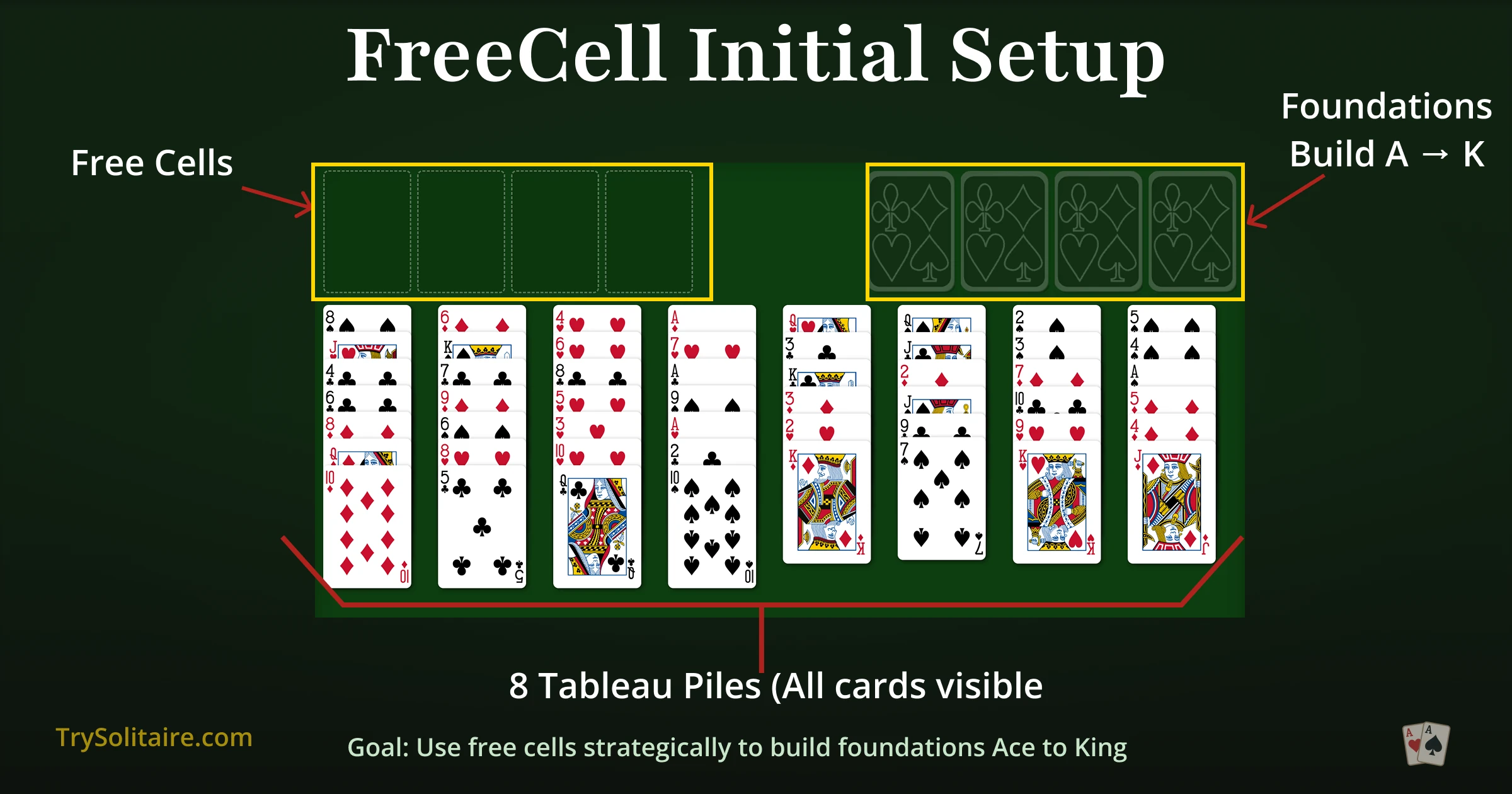
FreeCell uses a standard 52-card deck dealt into four distinct areas:
- Tableau (8 Columns): All 52 cards are dealt face-up into eight columns. The first four columns receive 7 cards each, and the last four columns receive 6 cards each. All cards are visible from the start.
- Free Cells (4 Spaces): Four empty spaces in the upper left corner where you can temporarily store individual cards. Each cell holds exactly one card at a time.
- Foundations (4 Piles): Four empty foundation piles in the upper right corner where you'll build complete sequences from Ace to King, separated by suit (hearts, diamonds, clubs, spades).
The most distinctive feature of FreeCell is the complete visibility of all cards from the beginning. There are no face-down cards, no stock pile, and no hidden information. Every decision you make is based on perfect knowledge of the entire deal.
Basic Rules of FreeCell
FreeCell follows specific movement rules that create its strategic depth:
- Tableau Building: Cards on tableau columns must be built in descending order (King to Ace) with alternating colors (red on black, black on red). For example, a red 9 can be placed on a black 10, or a black Jack can be placed on a red Queen.
- Foundation Building: Foundation piles build upward from Ace to King in the same suit. Only Aces can start a foundation. A 2 of hearts goes on Ace of hearts, a 3 of hearts on 2 of hearts, and so on.
- Free Cell Usage: Any exposed card can be moved to an empty free cell. Cards in free cells can be moved to tableau columns (following tableau rules) or to foundations (following foundation rules).
- Moving Card Sequences: You can move sequences of cards between tableau columns, but the number of cards you can move depends on available free cells and empty columns. The formula is: (empty free cells + 1) × (empty columns + 1). With no empty columns and no empty free cells, you can only move one card at a time.
- Empty Columns: When a tableau column becomes empty, you can place any card or valid sequence there. Empty columns are extremely valuable - they effectively double your moving capacity.
- Only Aces Start Foundations: Foundation piles must begin with an Ace. You cannot place any other card on an empty foundation.
How to Win FreeCell
You win when all 52 cards are moved to the four foundation piles, with each foundation containing a complete sequence from Ace to King in a single suit. Since almost every FreeCell game is winnable, success depends entirely on finding the correct sequence of moves. There's no luck involved - only strategy, planning, and logical deduction.
Pro Tip: The key to winning FreeCell is planning ahead. Before making any move, ask yourself: "Does this move create or block future opportunities?" Expert players routinely plan 10-20 moves ahead, visualizing how cards will cascade and which sequences need to be built.
The 4 Free Cells Explained: Your Most Valuable Resource
Free cells are the defining feature that makes FreeCell unique among all solitaire variants. Understanding how to use them strategically separates beginners from experts.
What Are Free Cells?
Free cells are four temporary parking spaces for individual cards. Think of them as "holding areas" where you can temporarily store cards that are blocking your progress. Each cell can hold exactly one card at any time, and cards can be moved freely between free cells, tableau columns, and foundations as long as they follow the game's rules.
Strategic Free Cell Usage
Mastering free cell management is essential for winning consistently:
- Keep Them Empty When Possible: Empty free cells provide maximum flexibility. Every filled free cell reduces your ability to move card sequences. Only use free cells when necessary to unlock critical moves.
- Free Cells Enable Sequence Moves: The number of empty free cells determines how many cards you can move as a sequence. With all 4 cells empty and one empty column, you can move sequences of up to 10 cards at once!
- Use Free Cells Temporarily: Ideally, cards should move through free cells quickly rather than sitting there permanently. Use them to rearrange cards, then empty them for future moves.
- Avoid Filling All Free Cells: Having all four free cells occupied simultaneously severely limits your options. If you find all cells filled, you've likely made strategic errors several moves earlier.
- Prioritize Which Cards to Store: Store cards in free cells that are blocking important sequences or preventing access to deeply buried cards. Don't waste free cells on cards that aren't causing problems.
The Free Cell Mathematics
Moving Capacity Formula: (Empty Free Cells + 1) × 2Empty Columns = Maximum Cards in Sequence
Examples:
- 4 empty cells + 0 empty columns: Can move 5 cards (5 × 20 = 5 × 1)
- 2 empty cells + 1 empty column: Can move 6 cards (3 × 21 = 3 × 2)
- 4 empty cells + 1 empty column: Can move 10 cards (5 × 21 = 5 × 2)
- 4 empty cells + 2 empty columns: Can move 20 cards (5 × 22 = 5 × 4)
- 0 empty cells + 0 empty columns: Can move only 1 card (1 × 20 = 1 × 1)
Notice how empty columns provide exponential benefit - each additional empty column doubles your moving capacity! This is why creating and preserving empty columns is one of the most powerful strategic advantages in FreeCell.
FreeCell vs Klondike: Which Should You Play?
FreeCell and Klondike are the two most popular solitaire variants, but they offer completely different experiences. Here's a detailed comparison to help you choose:
| Feature | FreeCell | Klondike |
|---|---|---|
| Win Rate | 99.99% with perfect play | ~79% with perfect play |
| Skill vs Luck | 95% skill, 5% luck | 60% skill, 40% luck |
| Card Visibility | All 52 cards visible from start | 21 cards face-down initially |
| Special Mechanics | 4 free cells for temporary storage | Stock pile with Draw 1 or Draw 3 |
| Average Game Time | 12-15 minutes | 8-12 minutes |
| Difficulty | Higher strategic complexity | Simpler rules, easier to play casually |
| Tableau Columns | 8 columns (all cards face-up) | 7 columns (most cards face-down) |
| Planning Required | 5-20 moves ahead | 2-5 moves ahead |
| Best For | Strategic thinkers, puzzle enthusiasts | Quick games, casual players |
| Frustration Level | Low (losses are usually your fault) | Medium (bad deals can be unwinnable) |
The Verdict: Choose FreeCell if you want a deep, strategic challenge where skill determines outcomes. Choose Klondike if you prefer faster games with an element of surprise. Both are excellent - it just depends on your mood and how much time you want to invest in planning. Many players enjoy both variants for different reasons!
For a deeper analysis, read our comprehensive FreeCell vs Klondike comparison guide.
FreeCell Strategy & Tips: How to Win More Consistently
FreeCell's high win rate means strategy matters more than any other solitaire variant. Follow these expert strategies to dramatically improve your success rate:
Essential Winning Strategies
- Keep Free Cells Empty: Your most important rule. Empty free cells provide maximum flexibility. Only fill them when it creates a clear advantage. If all four cells are full, you're probably stuck.
- Create Empty Columns Early: Empty tableau columns are worth two free cells in terms of moving capacity. Prioritize creating at least one empty column in the opening moves.
- Build Foundations Evenly: Don't rush one suit far ahead of others. Keep foundations within 2-3 cards of each other. Building one suit to King while others are at 5-6 creates card blockages.
- Expose Deeply Buried Cards First: Prioritize moves that expose cards at the bottom of long columns. These cards often determine whether you can create the sequences needed to win.
- Plan Entire Move Sequences: Don't make individual moves - plan entire sequences of 5-10 moves. Before moving any card, trace the complete path needed to achieve your goal.
- Use the Undo Button Freely: FreeCell rewards experimentation. Try different move sequences, undo if they don't work, and try another approach. Learning comes from exploring alternatives.
- Focus on One Problem at a Time: Identify the biggest blockage (usually a deeply buried card or poor sequence) and focus all your moves on solving that specific problem.
- Don't Rush Cards to Foundations: Sometimes keeping cards in the tableau provides more flexibility than moving them to foundations. Only move cards up when it clearly helps or doesn't hurt future moves.
Advanced Strategy: When stuck, work backwards from the goal. Identify which cards need to be in foundations last, then trace backwards to determine the sequence needed to get there. This "reverse planning" often reveals move sequences that aren't obvious when planning forwards.
Common Mistakes to Avoid
- Filling All Free Cells at Once: This is the #1 beginner mistake. Once all cells are full, you can only move one card at a time, severely limiting options.
- Moving Cards to Foundations Too Quickly: Aces and Twos can usually go up safely, but moving higher cards too early can block future sequences.
- Not Planning Ahead: Making reactive moves instead of planning sequences leads to dead ends. Always plan at least 3-5 moves ahead.
- Ignoring Empty Column Opportunities: Failing to prioritize creating empty columns wastes your most powerful asset.
- Giving Up Too Soon: Many positions that look impossible have solutions. Keep trying different approaches before restarting.
Best FreeCell Strategy for Beginners
New to FreeCell? Start with these beginner-friendly principles: Keep at least two free cells empty at all times, create your first empty column within the first 10-15 moves, and move only Aces and Twos to foundations initially. Practice planning just 2-3 moves ahead until it becomes natural, then gradually extend your lookahead. Use the undo button liberally - it's a learning tool, not cheating. Most importantly, focus on exposing cards in the deepest columns first, as these often contain the keys to solving the entire puzzle.
For comprehensive strategy tutorials, visit our Complete FreeCell Strategy Guide and Advanced Tips & Tricks.
FreeCell Strategy for Perfect Games
Achieving near-perfect FreeCell win rates (95%+) requires mastering advanced techniques beyond basic strategy. These expert-level approaches will help you solve even the most challenging deals:
Supermove Calculations and Pattern Recognition
Expert FreeCell players recognize "supermove" patterns instantly - positions where multiple cards can be moved as a group even without manually using free cells. The game automatically calculates these moves: with 2 empty free cells and 1 empty column, you can move 6 cards at once. Recognizing these opportunities without counting saves time and reveals solutions faster. Practice visualizing supermove capacity at a glance.
Foundation Building Timing Strategy
When to move cards to foundations separates good players from great ones. The rule: keep cards in tableau if they might be needed for building sequences. Move to foundations when: 1) The card is Ace or Two (almost always safe), 2) Moving it won't block lower-ranked cards of the opposite color, 3) Both cards of the opposite color and one rank higher are already in foundations. For example, move the 7 of Hearts only after both black 8s are in foundations.
Analyzing Opening Positions
The first 5-10 moves determine FreeCell game outcomes. Analyze the opening layout systematically: Identify buried Aces (highest priority to expose), locate Kings blocking deep cards, check for obvious empty column opportunities, and scan for long in-suit sequences that can be leveraged. Expert players spend 30-60 seconds analyzing before making the first move - this upfront planning prevents mid-game dead ends.
Endgame Automation and Auto-Move
In the endgame when most cards are in foundations, learn to recognize "auto-win" positions where the remaining moves are forced. Once all cards below 5 are in foundations and no cards are blocking others, the position is essentially solved. Many FreeCell implementations (including TrySolitaire) offer auto-complete features that recognize these positions and finish the game automatically.
Practicing with Difficult Deals
To rapidly improve, deliberately practice difficult FreeCell deals. Replay games you lost and use unlimited undo to explore alternative move sequences. Compare your solution with optimal play (if available). Track which types of positions give you trouble - empty column creation? Foundation timing? Supermove recognition? - then focus practice on your weak areas.
The Path to 95%+ Win Rates
Achieving elite-level FreeCell performance takes dedication: Start by reaching 70% win rate with basic strategies, then 85% by mastering empty column creation and foundation timing. Breaking 90% requires supermove recognition and deep planning. Reaching 95%+ demands thousands of games, pattern memorization, and the ability to plan 15-20 moves ahead. Compare your progress with players in our solitaire games collection to see how different variants challenge different skills!
Why Play FreeCell on TrySolitaire?
TrySolitaire offers the best FreeCell experience available online, with features designed specifically for both casual players and serious strategists:
✓ 100% Free Forever
No ads, no paywalls, no hidden costs. Play unlimited FreeCell games completely free. We believe strategic games like FreeCell should be accessible to everyone without distractions or manipulation.
✓ Unlimited Undo/Redo
FreeCell rewards experimentation and learning. Our unlimited undo system lets you explore different move sequences without penalty. Try approaches, undo if they don't work, and discover optimal solutions through exploration.
✓ Works Completely Offline
Progressive Web App (PWA) technology means FreeCell works perfectly without internet connection. Ideal for flights, commutes, or anywhere without reliable WiFi. Visit once while online, play forever offline.
✓ Comprehensive Statistics
Track your improvement with detailed stats: games played, games won, win rate, best time, current winning streak, and best streak. Watch your win rate climb as you master FreeCell strategy.
✓ Mobile-Optimized Interface
Fully responsive design works perfectly on phones, tablets, and desktops. Touch-optimized controls make mobile FreeCell smooth and intuitive. Play anywhere, anytime.
✓ No Sign-Up Required
Start playing immediately. No email, no password, no personal information. Your privacy matters to us - all stats are stored locally in your browser.
✓ Multiple Card Themes
Customize your experience with 4 card styles and 9 card back designs. Choose the look that's easiest on your eyes during long FreeCell sessions.
✓ Timer & Move Counter
Track your time and moves to challenge yourself. Can you solve that difficult deal in under 200 moves? Can you beat your personal best time?
✓ 15 Additional Games
Beyond FreeCell, enjoy Klondike, Spider, Pyramid, Golf, and 11 more solitaire variants, plus puzzle games like Sudoku and 2048.
▶ Play FreeCell Solitaire NowFrequently Asked Questions About FreeCell
Related Solitaire Games & Resources
Explore our complete solitaire games collection with 13 strategic variants. New to solitaire? Start with our comprehensive solitaire guide, try Klondike for the classic experience, or compare Spider Solitaire as another strategic option.
Learn More About FreeCell & Solitaire
- Complete FreeCell Strategy Guide
- FreeCell vs Klondike: Detailed Comparison
- Expert Solitaire Tips & Tricks
- How to Win More Solitaire Games
- Complete Guide to Solitaire Variants
- The Fascinating History of Solitaire
- Best Solitaire Games Ranked
- Hardest Solitaire Games
- Easiest Solitaire Games for Beginners
- How to Play Solitaire
- Advanced Solitaire Strategy
- Common Solitaire Mistakes to Avoid
- Solitaire Terms Glossary
- Solitaire Difficulty Rankings
- Ultimate Solitaire Comparison Guide
Ready to Master FreeCell?
Join millions of strategic thinkers who have made FreeCell their favorite mental challenge. With 99.99% of games winnable through skill alone, FreeCell offers the ultimate test of solitaire mastery. No downloads, no ads, no complications - just pure strategic gameplay.
▶ Start Playing FreeCell Free Now