Klondike Solitaire: The Classic Card Game
Last updated: November 15, 2025
Klondike Solitaire is the timeless card game that has captivated players for over a century. Known simply as "Solitaire" to millions worldwide (or "Patience" in British English), Klondike is the quintessential single-player card game that combines strategy, patience, and a touch of luck. Whether you remember it from the iconic Windows Solitaire or discovered it through physical card decks, Klondike remains the most popular solitaire variant with 165,000 people searching for it every month.
What makes Klondike Solitaire special? Unlike pure luck-based games, Klondike rewards strategic thinking and forward planning. Research shows that 79% of Klondike Turn 1 games are theoretically winnable with perfect play, meaning your decisions truly matter. Available in two main variants—Turn 1 (easier, drawing one card at a time) and Turn 3 (harder, drawing three cards at a time)—Klondike offers the perfect challenge for beginners and experts alike.
At TrySolitaire, you can play Klondike Solitaire completely free with no ads, no sign-up required, and full offline support. Our built-in solver tells you instantly whether your game is winnable, lets you deal guaranteed-solvable hands, and offers automatic undo-to-winnable recovery when you get stuck. Enjoy unlimited undo, customizable card styles, statistics tracking, and both Turn 1 and Turn 3 modes. Whether you have 5 minutes or an hour, Klondike Solitaire is always ready for a quick mental challenge.
Quick Start Guide: Play Klondike in 30 Seconds
Never played Klondike Solitaire before? No problem! Here's how to start playing immediately:
- Understand the Goal: Move all 52 cards to the four foundation piles (top right), building each suit from Ace to King.
- Learn Tableau Moves: In the seven tableau columns, stack cards in descending order with alternating colors—red on black, black on red (e.g., red 7 on black 8).
- Draw from the Stock: Click the stock pile (top left) to reveal new cards. In Turn 1 mode, you draw one card; in Turn 3 mode, you draw three cards at a time.
- Start with Aces: Always move Aces to the foundations immediately—they're the foundation of each pile and have no downside to moving early.
- Expose Hidden Cards: Prioritize moves that flip face-down cards in the tableau, as revealing new cards gives you more options and opportunities.
That's it! Click the "Play Now" button above and you'll be playing Klondike Solitaire within seconds. The intuitive drag-and-drop interface makes it easy to move cards, and the unlimited undo button means you can experiment with different strategies without pressure.
Klondike Turn 1 vs Turn 3: Which Should You Play?
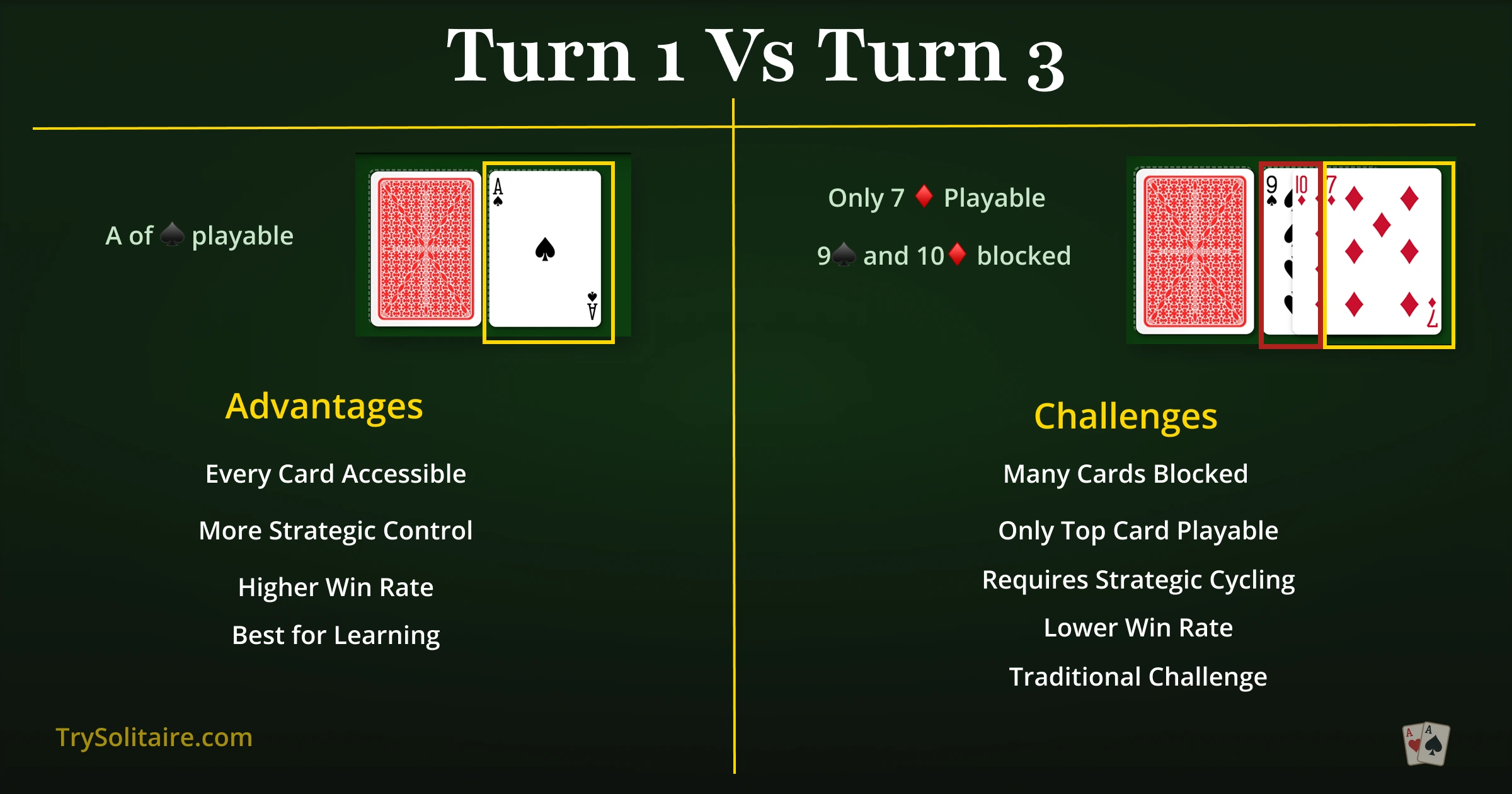
Klondike Solitaire comes in two main variants that differ in difficulty based on how you draw cards from the stock pile. Understanding the difference helps you choose the right challenge for your skill level.
Turn 1 Klondike
Difficulty: Medium
Draw Style: One card at a time
Best For: Learning, strategic play, maximizing wins
Turn 1 Klondike draws one card at a time from the stock pile, making every card accessible when you need it. This variant offers the highest win rate (79% with perfect play) and rewards careful planning. Ideal for players who want to focus on strategy rather than luck.
Turn 3 Klondike
Difficulty: Hard
Draw Style: Three cards at a time
Best For: Challenge seekers, traditional play, quick games
Turn 3 Klondike draws three cards at a time with only the top card playable. This classic variant is significantly harder (only 30% winnable) as many cards become temporarily trapped. The traditional solitaire experience that tests both skill and patience.
Which variant should you choose? If you're new to Klondike Solitaire or want to maximize your win rate while learning advanced strategies, start with Turn 1. It's the perfect training ground for understanding optimal play patterns. Once you're consistently winning Turn 1 games, challenge yourself with Turn 3 for a true test of strategic foresight and adaptability. Many expert players enjoy both variants for different reasons: Turn 1 for satisfying strategic depth, and Turn 3 for its unforgiving challenge.
Both variants are available instantly at TrySolitaire—just select your preferred mode from the settings menu before starting a new game.
Which Mode Should You Choose?
- Are learning Klondike for the first time
- Want more strategic control over your moves
- Prefer a higher chance of winning (79% vs 30%)
- Enjoy planning multiple moves ahead
- Like having access to every card in the deck
- Want the traditional, classic Klondike experience
- Seek a more challenging game with lower win rates
- Are comfortable with luck playing a bigger role
- Have mastered Turn 1 and want to test your skills
- Enjoy games where many cards may be inaccessible
How to Play Klondike Solitaire: Complete Rules
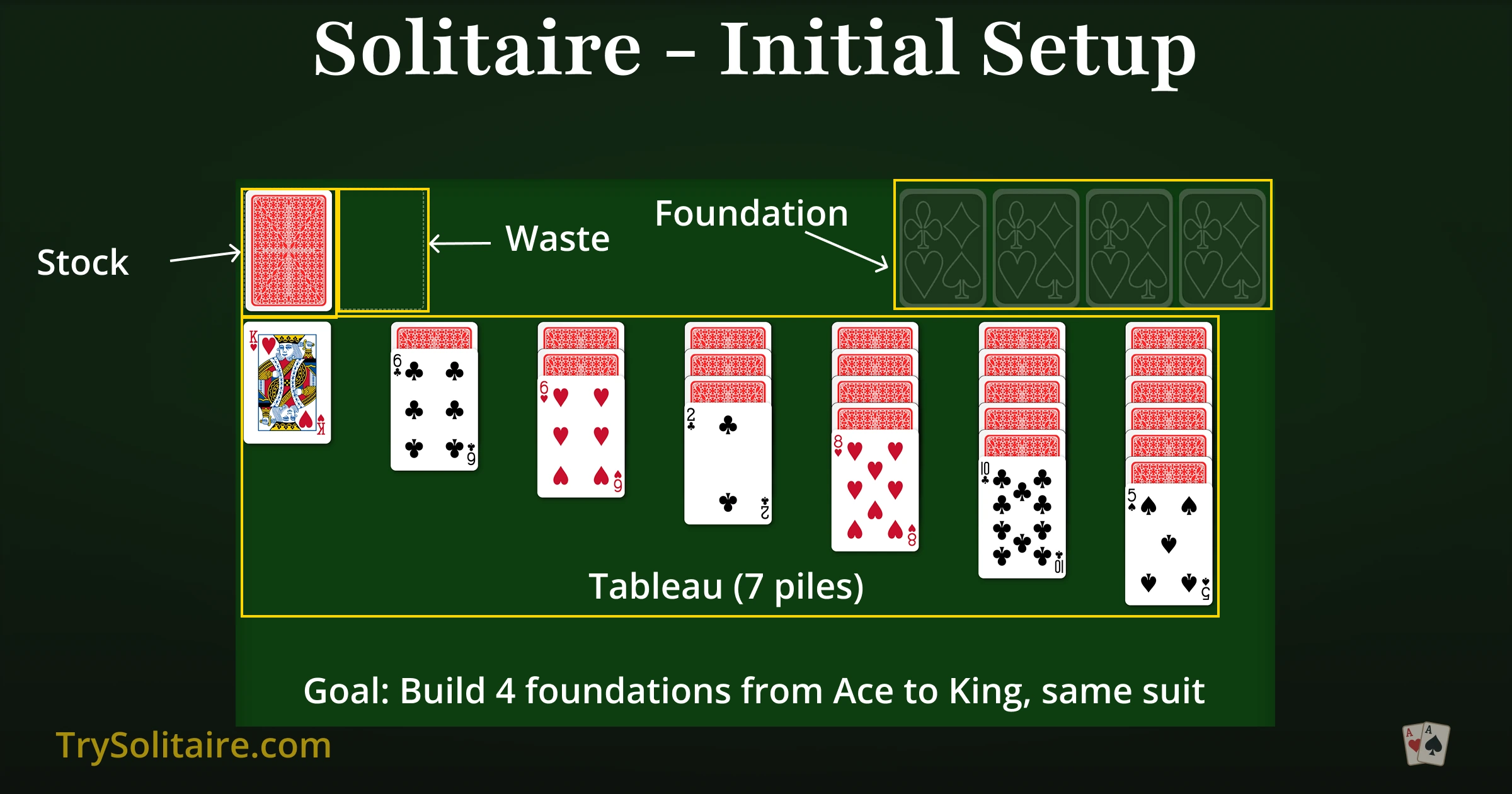
Klondike Solitaire is played with a standard 52-card deck. The game area consists of four distinct zones, each serving a specific purpose in your quest to win:
Game Layout and Card Areas
- Tableau (7 columns): The main playing area with seven columns of cards. The first column has 1 card, the second has 2 cards, continuing up to 7 cards in the seventh column. Only the top card in each column starts face-up, with all other cards face-down. This is where most of your strategic maneuvering happens.
- Foundations (4 piles): Located in the top-right corner, these four empty spaces are where you build your winning piles. Each foundation represents one suit (Hearts, Diamonds, Clubs, Spades) and must be built sequentially from Ace to King.
- Stock Pile: The face-down deck in the top-left corner containing the remaining 24 cards not dealt to the tableau. Click this pile to draw new cards into the waste pile.
- Waste Pile: Located next to the stock pile, this is where drawn cards are placed face-up. The top card of the waste pile is always available for play.
Objective
The goal of Klondike Solitaire is to move all 52 cards to the four foundation piles, building each foundation from Ace to King in the same suit. You win when all four foundations are complete (Ace through King in Hearts, Diamonds, Clubs, and Spades).
Legal Moves in Klondike
Understanding what moves are allowed is crucial to mastering Klondike. Here are the complete rules for moving cards:
Moving Cards to Foundations:
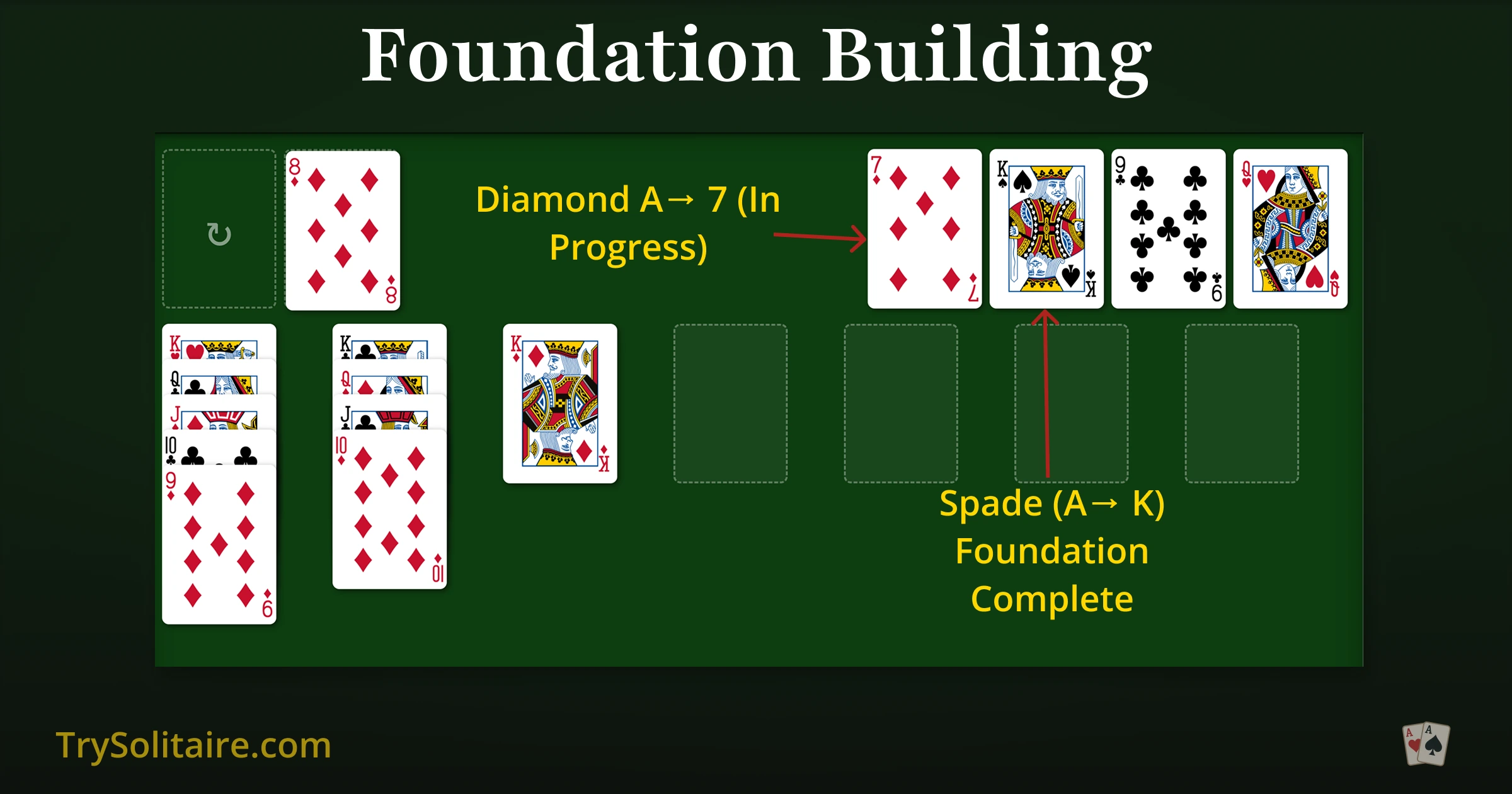
- Foundations must start with an Ace and build upward in the same suit: A → 2 → 3 → 4 → 5 → 6 → 7 → 8 → 9 → 10 → J → Q → K
- You can move cards to foundations from the tableau, waste pile, or even from other foundations (though this is rarely beneficial)
- Only one card can be moved to a foundation at a time—you cannot move sequences
- Example: If the Hearts foundation shows a 5♥, you can only place the 6♥ on it next
Foundation Rules
- Each foundation builds ONE suit only (♥ ♦ ♣ ♠)
- Must start with an Ace (A) - No other card can begin a foundation
- Build in ascending order: A → 2 → 3 → 4 → 5 → 6 → 7 → 8 → 9 → 10 → J → Q → K
- Only ONE card at a time can be moved to a foundation
- Win when all 4 foundations complete! (52 cards total: 13 per foundation)
Moving Cards in the Tableau:
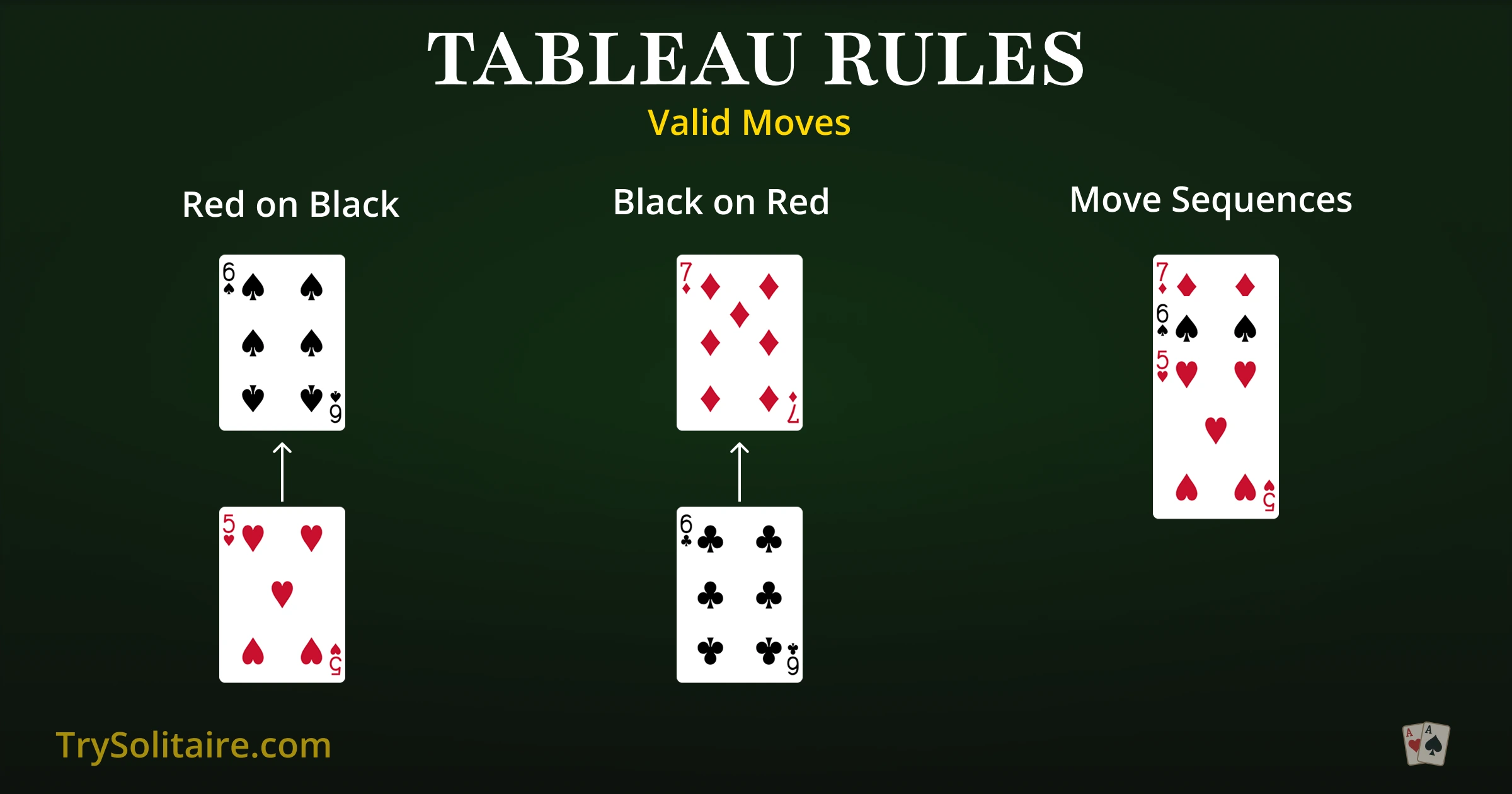
- Cards must be placed in descending rank order (King, Queen, Jack, 10, 9, 8, 7, 6, 5, 4, 3, 2)
- Cards must alternate colors: red cards (Hearts, Diamonds) must be placed on black cards (Clubs, Spades), and vice versa
- You can move single cards or entire sequences of cards that follow the alternating color and descending rank pattern
- Example: A black 8 can be placed on a red 9, then a red 7 on that black 8, then a black 6 on the red 7—this entire sequence (8-7-6) can be moved together as a unit
- Only Kings (or sequences starting with Kings) can be placed on empty tableau columns
- When you move a face-up card and reveal a face-down card beneath it, the face-down card automatically flips face-up
✓ Valid Tableau Moves
✗ Invalid Tableau Moves
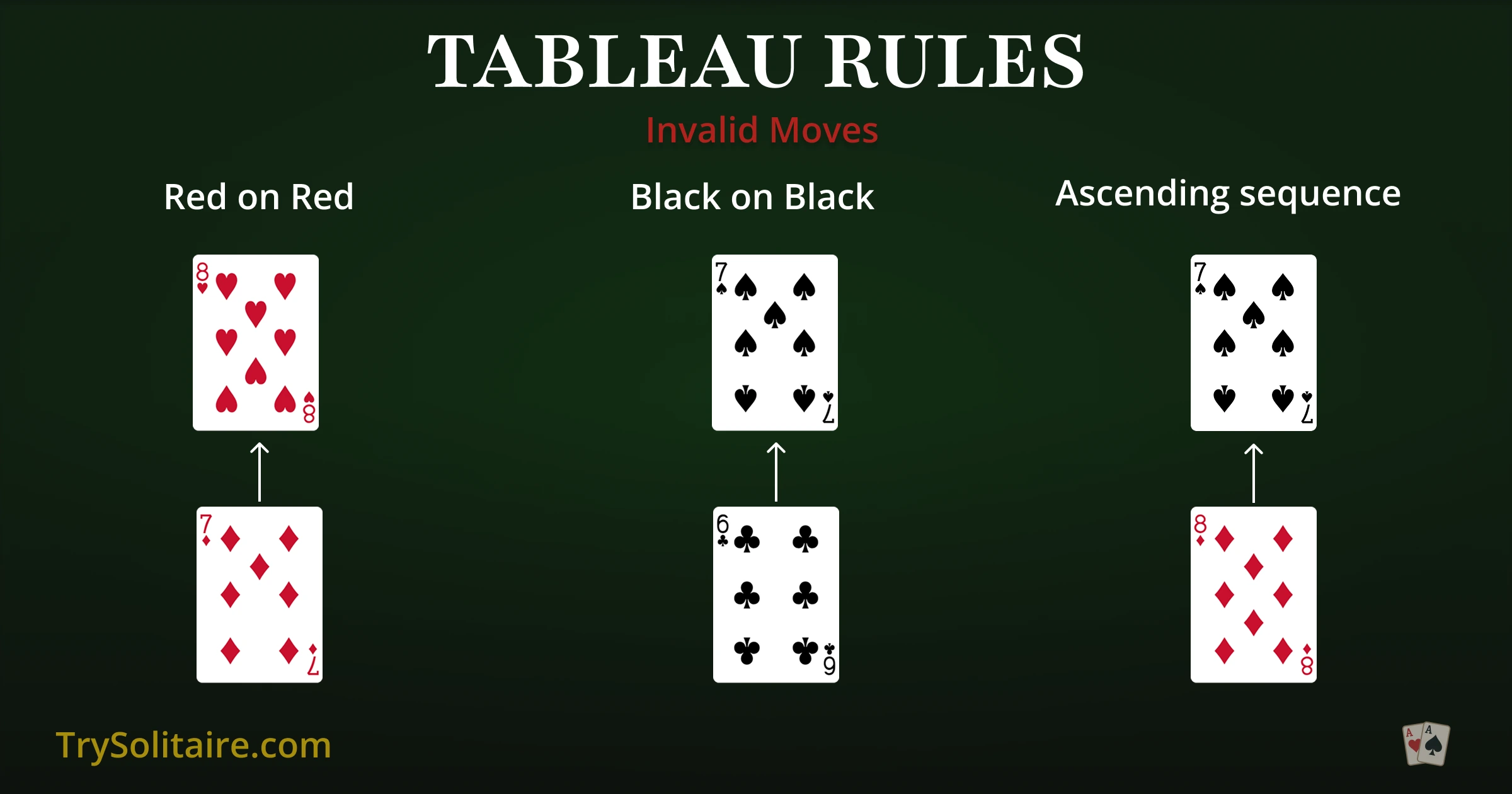
Tableau Rules Summary
- Descending rank order: K→Q→J→10→9→8→7→6→5→4→3→2→A
- Alternating colors: Red (♥ ♦) ↔ Black (♠ ♣)
- Move single cards or complete sequences
- Only Kings can fill empty columns
Drawing from the Stock Pile:
- Turn 1 Mode: Click the stock to draw one card at a time into the waste pile. The drawn card is immediately available for play.
- Turn 3 Mode: Click the stock to draw three cards at a time. Only the top card of the three is playable; you must use it before accessing the cards beneath.
- When the stock is empty, click the empty space to recycle the waste pile back into the stock and continue drawing
- TrySolitaire allows unlimited recycling in both modes, giving you maximum strategic flexibility
Winning and Losing
You win when all 52 cards have been successfully moved to the four foundations, with each foundation showing a complete sequence from Ace to King in one suit.
You lose when no legal moves remain and you cannot progress further toward victory. This happens when all tableau columns are blocked, the stock has been fully cycled, and no cards can be moved to foundations or between tableau columns. In TrySolitaire, you can use the unlimited undo feature to try different move sequences and avoid premature losses.
Klondike Strategy Guide: Win More Games
While Klondike Solitaire involves some luck in the initial deal, expert players can achieve win rates of 40-50% in Turn 1 mode by following proven strategies. Here are the essential strategic principles that separate casual players from Klondike masters:
Essential Klondike Strategies
- Always Move Aces and 2s to Foundations Immediately: Unlike higher-ranked cards, Aces and 2s have no strategic value in the tableau. Moving them to foundations creates space and reduces clutter without any downside. Don't hesitate—get them out of the way.
- Expose Face-Down Cards First: The single most important strategic principle in Klondike is revealing hidden cards. Every face-down card you flip gives you more information and more options. When choosing between two moves, always prefer the one that flips a new card, even if the alternative seems more immediately beneficial.
- Build Tableau Columns Evenly: Avoid building one or two columns extremely high while leaving others short. Balanced columns give you more flexibility and movement options. If one column has 10 cards while others have 2-3, you've likely made suboptimal moves.
- Empty Columns Are Powerful—Use Them Wisely: Empty tableau columns are incredibly valuable because only Kings can fill them. Before creating an empty column, ensure you have a King (or a good chance of revealing one) to place there. An empty column can serve as a temporary holding area for sequences, enabling complex multi-move combinations.
- Don't Rush Cards to Foundations: While it's tempting to move every possible card to the foundations, sometimes you need low-ranked cards (3s, 4s, 5s) to build tableau sequences. Before moving a card to a foundation, ask: "Will I need this card in the tableau soon?" This is especially important for cards in the 3-7 range.
- Prioritize Moves That Create More Moves: Think one or two steps ahead. The best moves aren't just legal—they're moves that enable additional moves afterward. For example, moving a card that allows you to flip a face-down card is better than a move that simply changes the tableau arrangement.
- Cycle Through the Stock Strategically: In Turn 1, you can cycle through the stock multiple times to find the exact card you need. In Turn 3, timing is crucial—sometimes you should delay cycling through the stock until you've exhausted all tableau moves, as cycling might bury a currently accessible card you need.
- Learn to Recognize Dead Ends Early: Some deals simply aren't winnable. If you've cycled through the stock 2-3 times and made no progress, the deal might be impossible. Recognizing unwinnable situations saves time and frustration—don't be afraid to start a new game.
- Use the Undo Button Liberally: TrySolitaire's unlimited undo feature lets you experiment with different move sequences without penalty. Found yourself in a dead end? Undo 10 moves and try a different approach. This trial-and-error process is how you develop intuition for optimal play.
- Master Turn 1 Before Attempting Turn 3: Turn 3 Klondike requires all the Turn 1 strategies plus additional foresight about stock cycling. Build your strategic foundation with Turn 1, then graduate to Turn 3 when you're consistently winning 30-40% of Turn 1 games.
Advanced Strategic Concepts
Sequence Preservation: When you have a choice between breaking up a long alternating sequence or keeping it intact, preservation is often better. A sequence like K-Q-J-10-9-8-7 can be moved as a unit, giving you incredible flexibility. Breaking it apart means you'll need to rebuild it later, wasting moves.
King Placement Timing: Since Kings can only go in empty columns, placing a King is a significant commitment. Wait until you've revealed several face-down cards and have a clearer picture of the game state before committing Kings to empty columns. A poorly placed King can block crucial moves later.
Foundation Return Strategy: Advanced players sometimes move cards from foundations back to the tableau when a low-ranked card is needed to continue a sequence. For example, if you have a 4 in the foundation but need it to place a 3 on, moving it back can unlock the game. Use this technique sparingly and strategically.
Color Distribution Awareness: Pay attention to whether you have roughly equal numbers of red and black cards available. If your tableau is all red cards, you can only make moves when black cards appear from the stock. Balanced color distribution maintains flexibility.
By internalizing these strategies and practicing regularly, you'll see your Klondike win rate climb steadily. Remember: every game is a learning opportunity, even the losses!
Built-in Klondike Solver: Know If Your Game Is Winnable
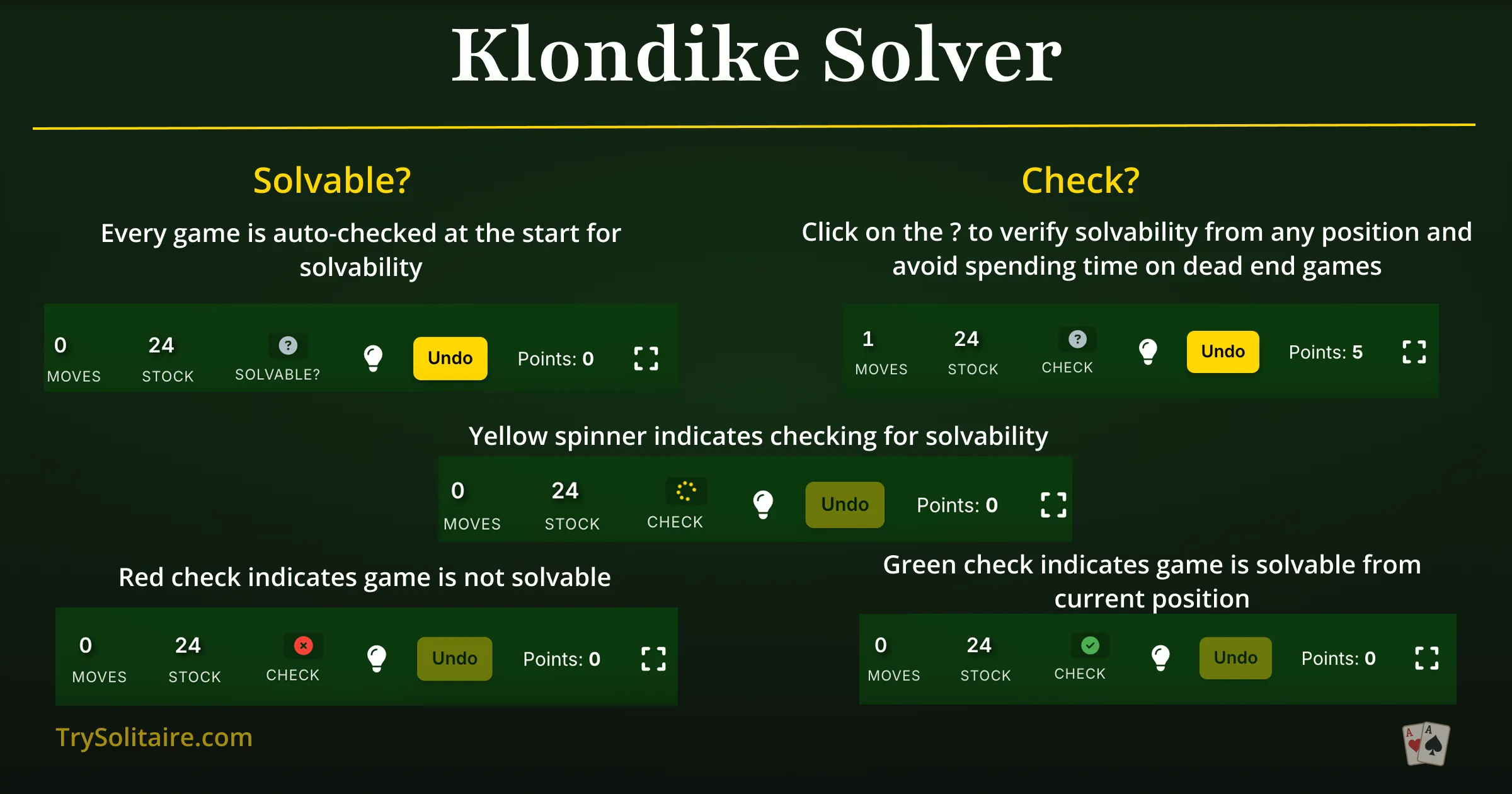
TrySolitaire is one of the only solitaire websites featuring a built-in Klondike solver that runs entirely in your browser. No more wondering whether you're stuck because of a bad move or an unwinnable deal — our solver analyzes your game position in real time and tells you whether a winning path still exists.
How to Use the Klondike Solver
The solver integrates seamlessly into your gameplay. Here's everything it can do:
Solver Status Icons
- Green Checkmark — A winning path exists from your current position. Keep playing strategically!
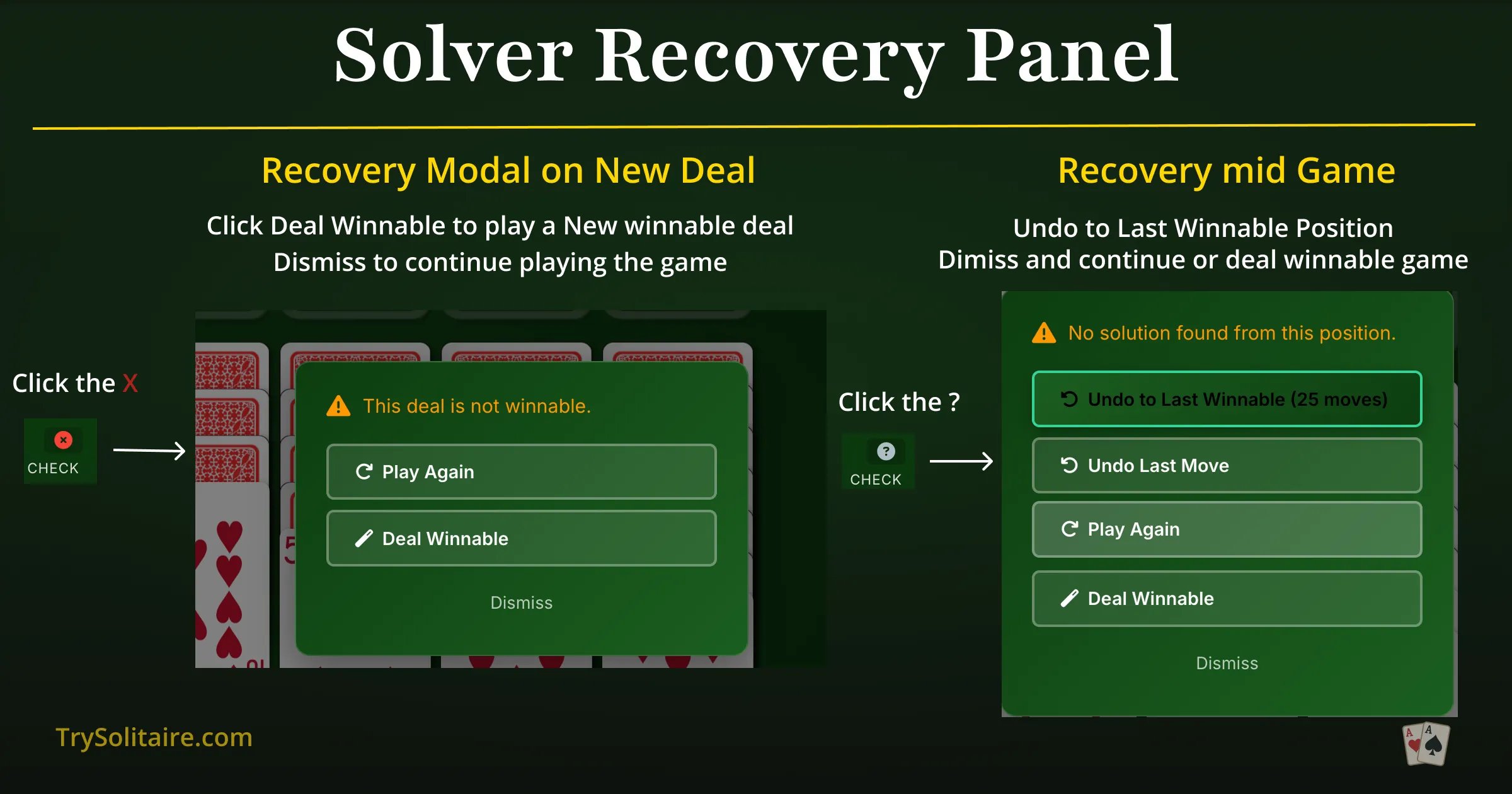
- Red X — No solution exists. Click for recovery options including undo-to-winnable.
- Gold Spinner — The solver is analyzing your position. This typically completes within seconds.
- Gray Question Mark — Position not yet checked. Click to trigger an analysis.
Solver-Powered Features
1. Real-Time Solvability Check
Click the solver icon in the game toolbar at any point during your game. The solver uses a depth-first search algorithm that evaluates up to 10 million move combinations to determine whether your current position has a winning path. The analysis runs in a background thread (Web Worker), so your game stays responsive while it calculates.
2. Deal Winnable Game
Tired of starting games that are impossible to win? The "Deal Winnable" option in the new game menu uses the solver to find a deal that is guaranteed to have at least one winning solution. Available in both Draw 1 and Draw 3 modes, this feature ensures you never waste time on an unwinnable hand.
3. Undo to Winnable
Made a bad move that killed your chances? When the solver detects an unsolvable position, the recovery panel offers to automatically undo your moves back to the last winnable state. This powerful feature lets you try a different strategy without starting completely over.
4. Background Seed Validation
When you start a new game, the solver automatically analyzes the deal in the background. Before you've even made your first move, you'll know whether the deal has a winning path — letting you make an informed choice about whether to commit to the game or deal again.
Why the Solver Changes Everything
Without a solver, Klondike Solitaire can be deeply frustrating. Research shows that 21% of Draw 1 deals and ~70% of Draw 3 deals are mathematically unwinnable — meaning no sequence of moves can lead to victory regardless of how well you play. Players often spend 10-15 minutes on these doomed games without knowing they never had a chance.
Our solver eliminates that frustration by giving you instant feedback on your game's solvability. This doesn't make the game easier — you still need skill and strategy to find the winning path. But it ensures you're always spending your time on games where victory is actually possible.
Solver Technical Details
- Algorithm: Depth-first search with iterative deepening
- Max Analysis: Up to 10 million move evaluations per check
- Performance: Runs in a background Web Worker — no game lag
- Privacy: 100% client-side — your game data never leaves your browser
- Modes: Supports both Draw 1 and Draw 3 Klondike
Want to learn more about how solitaire solvers work and what makes certain deals harder than others? Read our complete guide to the Klondike Solitaire Solver or learn how to tell if your solitaire game is winnable.
Klondike Win Rates and Statistics
One of the fascinating aspects of Klondike Solitaire is how the game balances skill and luck. Understanding the statistics behind Klondike helps set realistic expectations and appreciate the skill ceiling of this classic game.
Theoretical Win Rate: Turn 1 Klondike
of games are theoretically winnable with perfect play
According to extensive computer simulations and mathematical analysis, approximately 79% of Klondike Turn 1 deals have at least one winning solution. This means that in roughly 4 out of 5 games, the initial card distribution allows for victory if you make all the optimal moves. The remaining 21% of games are mathematically impossible to win regardless of strategy.
However, achieving a 79% win rate requires perfect play—knowing the optimal move at every decision point. In reality, even expert human players typically achieve win rates of:
- Beginner Players: 5-10% win rate (1 in 10-20 games)
- Intermediate Players: 15-20% win rate (1 in 5-7 games)
- Advanced Players: 25-35% win rate (1 in 3-4 games)
- Expert Players: 40-50% win rate (1 in 2-2.5 games)
The gap between the theoretical 79% and even expert players' ~50% win rate reveals Klondike's hidden depth. Many games have only one or two winning paths among dozens of possible move sequences, making it challenging to find the optimal route without computer-level calculation.
Turn 3 Klondike Statistics
Turn 3 Klondike (drawing three cards at a time) is significantly more difficult:
Theoretical Win Rate: Turn 3 Klondike
of games are winnable with perfect play
Only about 30% of Turn 3 deals are solvable, and typical player win rates range from 1-5% for beginners to 10-15% for experts. The three-card draw mechanic dramatically reduces available options, making many cards temporarily inaccessible.
Game Duration Statistics
- Average Winning Game: 8-12 minutes (casual pace), 2-4 minutes (expert pace)
- World Record Speed: Under 30 seconds for extremely favorable deals with perfect execution
- Average Game (Including Losses): 5-8 minutes, as unwinnable games are often abandoned early
Move Statistics
- Minimum Moves to Win: Theoretically as few as 52 moves (one per card), but practically 80-150 moves
- Average Winning Game: 120-180 moves including stock draws and repositioning
- Stock Cycles: Winning games typically cycle through the stock 2-5 times in Turn 1, 3-8 times in Turn 3
Track Your Statistics with TrySolitaire
TrySolitaire automatically tracks your Klondike statistics including:
- Games played and games won
- Current win streak and best win streak
- Best completion time
- Overall win rate percentage
Watching your win rate improve over time is one of the most satisfying aspects of Klondike Solitaire. As you internalize the strategies above, you'll see measurable progress in your statistics!
Klondike vs Other Solitaire Games
Klondike is just one of many solitaire variants, each with unique mechanics and strategic depth. Here's how Klondike compares to other popular solitaire games available at TrySolitaire:
| Game | Deck Size | Win Rate | Difficulty | Avg. Time | Key Feature |
|---|---|---|---|---|---|
| Klondike | 52 cards | 79% (Turn 1) | Medium | 8-12 min | Classic solitaire experience |
| Spider | 104 cards | 90% (1-suit) | Hard | 15-25 min | Build sequences K-A to remove |
| FreeCell | 52 cards | 99%+ | Medium-Hard | 10-15 min | Almost all deals winnable |
| Pyramid | 52 cards | ~50% | Medium | 5-8 min | Match cards totaling 13 |
| TriPeaks | 52 cards | 85-90% | Easy-Medium | 3-6 min | Fast-paced clearing game |
| Yukon | 52 cards | ~25% | Hard | 10-15 min | Klondike variant, no stock |
| Golf | 52 cards | ~20% | Medium-Hard | 3-5 min | Clear tableau in fewest moves |
Why Choose Klondike?
Klondike Solitaire stands out as the perfect balance between accessibility and strategic depth. Unlike FreeCell (where almost every game is winnable with perfect play), Klondike has meaningful variation—some deals are impossible, making victories feel earned. Unlike Spider Solitaire (which can take 20+ minutes per game), Klondike offers satisfying gameplay in 8-12 minutes, perfect for a coffee break.
Klondike's Turn 1 and Turn 3 variants mean you can adjust difficulty without learning a new game. Start with Turn 1 to learn strategies, then graduate to Turn 3 for an intense challenge. This flexibility, combined with its status as the most recognized solitaire game worldwide, makes Klondike the ideal starting point for solitaire enthusiasts.
Want to explore other solitaire variants? Check out our complete collection of 16 free solitaire and puzzle games, including Spider Solitaire, FreeCell, Pyramid, and more!
History of Klondike Solitaire
The exact origins of Klondike Solitaire are shrouded in mystery, but the game's name provides a significant clue to its historical roots. "Klondike" refers to the Klondike region in Canada's Yukon Territory, famous for the Klondike Gold Rush of 1896-1899, when approximately 100,000 prospectors traveled to the area seeking fortune.
The Gold Rush Connection
During the brutal Yukon winters, prospectors spent long months isolated in camps waiting for spring thaw to resume mining operations. Card games became a primary form of entertainment, and solitaire games (requiring only one player and a deck of cards) were particularly popular. While the exact origins remain unclear, Klondike Solitaire likely earned its name during this period, possibly invented or popularized by gold prospectors whiling away frozen winter nights.
The game's name reflects this heritage—just as prospectors hoped to strike gold through patience and luck, Klondike Solitaire players seek the elusive perfect game through careful strategy and fortunate deals. The parallel between mining for gold and "mining" through the card deck for winning sequences isn't coincidental.
Rise to Global Popularity
By the early 20th century, Klondike Solitaire had spread far beyond the Yukon, appearing in card game compendiums and becoming a parlor game staple. The game's simple rules and portable nature (requiring only a standard deck) facilitated its worldwide adoption. Throughout the 1900s, "Klondike" and "Solitaire" became increasingly synonymous in English-speaking countries.
The Microsoft Solitaire Revolution (1990)
Klondike Solitaire achieved true ubiquity with Microsoft's decision to include "Solitaire" (Klondike variant) in Windows 3.0 in 1990. This wasn't merely about entertainment—Microsoft deliberately included Solitaire to teach users how to use a mouse through intuitive drag-and-drop mechanics. The strategy worked brilliantly: millions of people learned mouse skills while playing Klondike.
Microsoft Solitaire became the most-played computer game in history, introducing entire generations to Klondike. For many people, "Solitaire" simply meant Klondike—other variants like Spider or FreeCell were seen as alternatives to "the original," even though Klondike is itself one variant among hundreds of solitaire games.
Modern Digital Era
Today, Klondike Solitaire remains one of the most-played games worldwide, with millions of daily players across desktop, mobile, and tablet platforms. Online versions like TrySolitaire have enhanced the classic game with features impossible in physical card form:
- Unlimited undo/redo functionality
- Automatic move suggestions and hints
- Statistics tracking across thousands of games
- Customizable visual themes and card styles
- Instant deal shuffling and game setup
From its probable origins in Yukon mining camps to its role teaching millions to use a computer mouse, Klondike Solitaire's journey mirrors the evolution of gaming itself. The core gameplay remains unchanged—building foundations from Ace to King—but the experience has been refined and enhanced for modern players.
Cultural Impact
Klondike Solitaire's cultural significance extends beyond gaming. The phrase "playing solitaire" in movies and literature typically means Klondike specifically. The game has appeared in countless films as a shorthand for boredom, contemplation, or passing time. Its presence on billions of computers has made Klondike perhaps the most universally recognized card game in human history.
Learn more about solitaire's rich history in our complete guide to solitaire games.
Frequently Asked Questions About Klondike Solitaire
What is Klondike Solitaire?
Klondike Solitaire is the classic solitaire card game that most people simply call "Solitaire". Played with a standard 52-card deck, the goal is to build four foundation piles from Ace to King, organized by suit. The game features seven tableau columns where you arrange cards in descending order with alternating colors (red on black, black on red). Klondike combines strategic planning with elements of chance, making it endlessly replayable and satisfying to master.
How do you win Klondike Solitaire?
You win Klondike Solitaire by moving all 52 cards to the four foundation piles, each sorted by suit from Ace to King. You build these foundations by strategically moving cards between the seven tableau columns (where cards must descend in rank with alternating colors), drawing from the stock pile (24 cards not initially dealt), and carefully planning your move sequences. The game ends in victory when all four foundations display a complete Ace-to-King sequence in their respective suits.
What percentage of Klondike games are winnable?
In Klondike Turn 1 (drawing one card at a time), approximately 79% of games are theoretically winnable with perfect play, though the average player wins only 15-20% of games due to the difficulty of finding optimal move sequences. In Klondike Turn 3 (drawing three cards at a time), the win rate drops to about 30% with perfect play, making it significantly more challenging. The gap between theoretical and practical win rates demonstrates Klondike's strategic depth and skill ceiling.
What's the difference between Turn 1 and Turn 3 Klondike?
Turn 1 Klondike allows you to draw one card at a time from the stock pile, making every card immediately accessible when drawn and resulting in a 79% theoretical win rate. Turn 3 Klondike requires drawing three cards at a time, where only the top card is playable until the cards beneath it are used. This makes Turn 3 much harder with only a 30% win rate, as many cards become temporarily inaccessible and require strategic cycling through the stock to reach them. Turn 1 is ideal for learning and strategic play, while Turn 3 offers a traditional challenge for experienced players.
Can you move cards from foundation back to tableau?
Yes, in most Klondike Solitaire implementations including TrySolitaire, you can move cards from the foundation piles back to the tableau. This strategic option lets you access low-ranked cards that might be needed to build tableau sequences or make other crucial moves. However, this should be done carefully and strategically, as moving cards back from foundations can sometimes complicate the path to victory. Advanced players use this technique to unlock blocked positions and create winning move sequences.
How do you score in Klondike Solitaire?
Traditional Klondike scoring awards 10 points for each card moved to a foundation, 5 points for moving a card from stock to tableau, and deducts 15 points for moving from foundation back to tableau. Time bonuses and move penalties may also apply in some versions. However, many modern Klondike implementations, including TrySolitaire, focus on tracking completion time and win rate percentage rather than points, as these metrics better reflect player skill and improvement. You can choose to play with or without scoring based on your preference.
What happens when you run out of stock cards?
When you've drawn all cards from the stock pile and it's empty, you can recycle the waste pile (the cards you've already drawn) by clicking on the empty stock pile location. The waste pile cards are gathered and become the new stock pile, allowing you to continue drawing. In Turn 1 Klondike, you can recycle unlimited times until you win or determine the game is unwinnable. Some Turn 3 variations limit recycling to 2-3 passes, but TrySolitaire allows unlimited passes in both modes to maximize your strategic opportunities.
Is Klondike the same as regular Solitaire?
Yes, Klondike Solitaire is what most people mean when they say "Solitaire" or "Patience" (the British term). The name "Klondike" comes from the Canadian Klondike Gold Rush of the 1890s where the game was popularized, but it became so ubiquitous that it's now synonymous with solitaire itself. Microsoft's inclusion of Klondike as simply "Solitaire" in Windows since 1990 cemented this association for billions of users worldwide. While hundreds of solitaire variants exist (Spider, FreeCell, Pyramid, etc.), Klondike remains the most recognized and played variant.
How long does a game of Klondike take?
A typical Klondike Solitaire game takes 5-15 minutes to complete for casual players, depending on thinking time and decision-making speed. Expert players can complete winning games in under 2-4 minutes by quickly recognizing optimal moves. Games that end in defeat are often abandoned after 3-5 minutes when it becomes clear no winning moves remain. The fastest recorded Klondike wins are under 30 seconds for extremely favorable deals with perfect execution, though such speed runs are rare and require both skill and luck.
What's the best strategy for Klondike Solitaire?
The best Klondike strategy involves several key principles: (1) Always move Aces and 2s to foundations immediately, (2) Prioritize moves that expose face-down cards in the tableau, (3) Keep tableau columns balanced rather than building one very high, (4) Create empty columns strategically for Kings, (5) Don't move cards to foundations too quickly if they might be needed for tableau building (especially 3s through 7s), (6) Think several moves ahead before committing to a sequence, (7) In Turn 3, time your stock cycling carefully to avoid burying needed cards. Mastering these strategies can increase your win rate from 10-15% to 40-50% over time.
Does TrySolitaire have a built-in solitaire solver?
Yes! TrySolitaire features a built-in Klondike solver that runs entirely in your browser using advanced depth-first search algorithms. The solver analyzes your current game position and tells you whether a winning path exists — displayed as a green checkmark (winnable), red X (unsolvable), or gold spinner (calculating) in your toolbar. It also powers the "Deal Winnable" feature (guaranteed solvable hands) and "Undo to Winnable" (automatic rewind to the last solvable position). Your game data never leaves your browser — the solver is 100% client-side. Read our complete Solitaire Solver guide to learn more.
How do I check if my solitaire game is winnable?
Click the solver status icon in the game toolbar at any point during play. The solver evaluates up to 10 million move combinations to determine if a winning path exists from your current position. If the solver finds your game is unsolvable, a recovery panel appears with options to undo to the last winnable state, deal a new game, or continue playing. You can also use the "Deal Winnable" option to start with a hand that's guaranteed to have a solution. Learn more in our guide on how to tell if your solitaire game is winnable.
Can I always start with a winnable solitaire game?
Yes. The "Deal Winnable" option in the new game menu uses the solver to find deals with at least one verified winning path. This works for both Draw 1 and Draw 3 Klondike modes. Since about 21% of Draw 1 deals and ~70% of Draw 3 deals are mathematically unwinnable, this feature saves you from spending time on impossible games. You still need skill to find the winning path — the solver just guarantees one exists.
More Solitaire Games to Explore
Love Klondike Solitaire? TrySolitaire offers 16 free solitaire and puzzle games with no ads and no sign-up required. Explore our complete solitaire games collection or try these popular alternatives:
Classic Solitaire Games
- Spider Solitaire - Strategic two-deck game with 1-suit, 2-suit, and 4-suit difficulty levels. Build King-to-Ace sequences to win.
- FreeCell - 99%+ of deals are winnable with perfect play! Use four free cells to strategically maneuver cards.
- Yukon Solitaire - A challenging Klondike variant with no stock pile. All cards are dealt to the tableau from the start.
- Pyramid Solitaire - Match cards totaling 13 to clear the pyramid. Fast-paced and addictive!
- TriPeaks Solitaire - Clear three peaks of cards in ascending or descending order. Quick games perfect for breaks.
- Golf Solitaire - Clear the tableau in as few moves as possible. Simple rules, surprising depth.
Advanced Solitaire Variants
- Russian Solitaire - Yukon's strategic cousin with unique building rules and high replay value.
- Scorpion Solitaire - Build tableau columns from King down to Ace. No foundations required!
- Canfield Solitaire - Originally played in casinos with strict rules. Challenge yourself!
- Forty Thieves - Two decks, strict building rules. One of the hardest solitaire games.
- Gaps Solitaire - Arrange cards in ascending order using strategic gaps. Unique puzzle-like gameplay.
- Accordion Solitaire - Compact all cards into one pile. Extremely challenging with a very low win rate.
Puzzle Games
- Sudoku - Daily challenges and multiple difficulty levels. Classic number puzzle game.
- 2048 - Combine numbered tiles to reach 2048. Includes relaxed and timed modes.
- Minesweeper - Classic logic puzzle game. Clear the board without hitting mines.
Popular Alternative Sites
Looking for more information about Klondike Solitaire? Check out these comprehensive guides:
- Solitaire for Seniors - The safest, large-print way to play online
- Google Solitaire Alternative - Why TrySolitaire offers a better experience than Google's version
- 247 Solitaire Alternative - Compare features and discover TrySolitaire's advantages
- Solitaire Bliss Alternative - Comprehensive feature comparison
- Solitaired Alternative - Find the best free solitaire experience
All games are completely free, work offline, and include unlimited undo, statistics tracking, and customizable themes. Start playing now!
Ready to Play Klondike Solitaire?
Join millions of players enjoying the classic card game with no ads, no sign-up, and completely free!
▶ Play Klondike Solitaire Free✓ Built-in solver | ✓ Deal winnable games | ✓ Turn 1 & Turn 3 modes | ✓ Unlimited undo | ✓ Statistics tracking | ✓ No ads ever